
Category: election automation
Press Release: IT experts fear “automated Garci,” call for parallel count in May 10 polls
 From left to right: Melvin Matulac (not in photo), Lito Averia, Bill Luz, Gus Lagman, Maricor Akol, Beng Coronel and Ben Garcia
A group of information technology (IT) professionals yesterday expressed fears of an “automated Garci” or high-tech cheating in the May 10 elections and called on the Commission on Elections (Comelec) to consider their proposal for a simplified parallel count in order to ensure the polls’ credibility
The IT experts, who spoke to media in a press conference initiated by the Movement for Good Governance (MGG), said recent developments have made many people wary and fearful of the possibility of a partial or even a total system failure, noting that the systems and processes that are in place are not fail-safe.
“While we agree with this observation, our concern today is more focused on the high probability of massive cheating in selected areas involving national, local and even party list positions,” said Augusto “Gus” Lagman, lead convenor of TransparentElections.Org.
Despite their apprehensions, he and other concerned IT professionals have chosen to cooperate with the Comelec “to give the Automated Election System (AES) a chance to succeed.” Some members of the group have been involved in the crafting of the Automated Election Law.
Ma. Corazon Akol, president of the Philippine National IT Standards Foundation (PhilNITS) and former president of the Philippine Electronics and Telecoms Foundation (PETEF), said Filipinos may be lulled into thinking that the May 10 elections would be free from cheating because it will be using “high tech” machines and computerized systems.
“The truth is that the Precinct Count Optical Scan (PCOS) machines, the operating and transmission programs and the whole system itself can be rigged, without our even knowing how or where the new and sophisticated “dagdag-bawas” scheme might be perpetrated,” she stressed.
The group presented several reasons for saying there is “grave and present danger” in the exercise of the Filipinos’ right of suffrage in the coming May 10 automated elections.
They cited a high probability that, a system “fully administered and constrolled by government insiders and their vendors” (quoting an election watchdog in the ISA), without adequate safeguards and full transparency, can contain hidden commands for the software and/or computer to execute.
They said these commands can be inserted in any of the computer programs contained in any of the PCOS machines or the computers that will be used to transmit the election results from the municipality and provincial sites. Pre-set results stored in the Compact Flash (CF) cards, tampering of digital results during transmission and results manipulation through canvassing programs are “not only feasible but also highly probable,” they added.
For expediency’s sake, they said, many safeguards set in place by law, as defined by “our colleagues in the IT industry,” were disregarded, removed or replaced with vulnerable alternatives. They noted that the pilot testing of the system was not done; the source code review, as strictly defined by law, was not granted; on-the-spot verification by the voter and the UV detector were disabled; and, controlled access features were disregarded.
Ma. Cristina Coronel, president of the Philippine Software Industry Association (PSIA), explained that their proposal for a simplified parallel count would only involve counting the votes for the president, the vice president and mayor.
She said the group’s time and motion studies indicated that it would only take about three hours for a precinct with 500 voters and five hours for a precinct with 1,000 voters to do the parallel count. She also gave assurance that it would not constitute a drain on government resources.
“Unless we do a full count at all precincts, of at least the top two positions, we cannot say with confidence that the coming elections in May is free fro any form of cheating,” she added.
The group appealed to Comelec chairman Jose Melo and the rest of the commission to sit down with them for a dialogue soon, as “time is running out,” so that together they can implement the recommendation and agree on solutions to both legal and logistics concerns.
Presentation: Parallel Manual Count by Gus Lagman
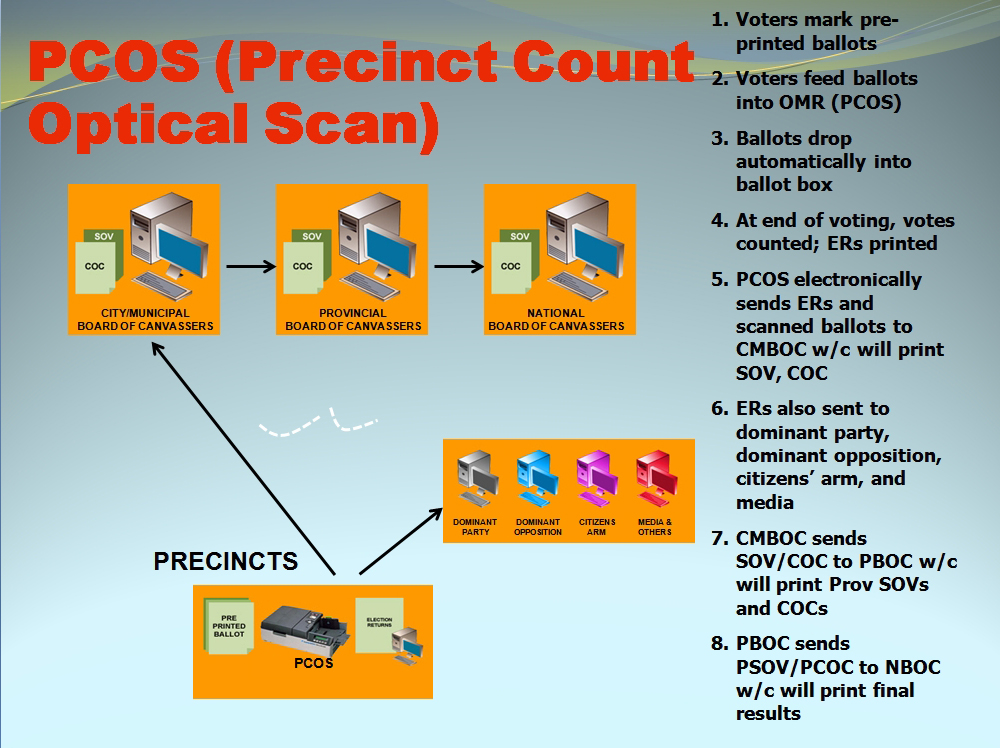
Why are we deeply concerned about the high probability of an automated “Garci”?
- Comelec chose a technology that counts votes in secret, when the election mantra today all over the world is “secret voting, public counting.”
- Comelec did not allow “source code” review.
- PCOS print-out/display of voters’ choices disabled.
- Smartmatic to generate both public and private keys; recently, Comelec said the keys will already be pre-fed into PCOS.
- Comelec will proclaim winners before audit is done.
- No General Instructions (GI) for random manual audit, continuity plan, protest process.
- UV ink check disabled.
- Smartmatic managing the whole process?
- Digital data to be transmitted to Dominant Party, Dominant Opposition, Citizens Arm, KBP, in round-about way.
How can “Garci” be automated?
- Hide a “cheating” program in PCOS (automated retail “dagdag-bawas”)
- Store preset results data in CF cards
- Tamper with digital results during transmission
- Manipulate results through canvassing programs (automated wholesale “dagdag-bawas”)
A parallel manual count will eliminate many of our concerns about an automated “Garci.” We can still do something to make our elections credible.
In implementing an IT system, a pilot run and/or a parallel run is always done. Despite a provision in the law, Comelec did not do a pilot run. This time, we have to demand that the Comelec at least does a parallel run. Manually count all ballots, but only on 3 positions – president, vice-president, and mayor.
Questions the Comelec might ask:
Q: It might delay the release of election results.
A: Our time and motion study shows that this extra step will only take 3 hours for a precinct with 600 voters.
Q: What if there are discrepancies between the PCOS and manual counts?
A: Until today, Comelec has been claiming that PCOS is accurate; if it’s not, then why did they choose this machine in the first place?
Q: But what if there are?
A: Then count the votes for all positions. This is estimated to take approx. 2 days and the canvassing an extra 2 days.
Q: There’s no time to prepare for it.
A: Part of their contingency plan is to print forms needed for manual counting. They might as well print for 100% of precincts.
Q: It’s difficult to implement.
A: It’s not. And it’s a small price to pay for credible elections.
Q: It’s not in the law.
A: The law does not prohibit it either.
Ours is a most reasonable request. It is a simple and most logical solution to the uncertainties in the coming election. There is absolutely no reason why the Comelec will not accept our recommendation. All they need to do is call. We are most willing to sit down with them to discuss the details of this solution.
Gus Lagman is lead convenor of TransparentElections.Org. Ph, former president of Information Technology Foundation of the Philippines (ITFP), former president of Philippine Computer Society (CSP), and former Technology Chief of NAMFREL. This presentation was given at a press conference initiated by the Movement for Good Governance (MGG) on April 13, 2010 at Dusit Thani Hotel, Makati City.
View the slides of the presentation or download the audio file.
Editorial: A promising election solution by Ernesto Ordoñez
 Manual precinct tallying
Our initial confidence in the Automated Election System (AES) has been shaken. Some say the AES may be worse than our fully manual voting system because of the easy way it can be rigged. With only four weeks to go before elections, many are now desperately looking for a solution.
Because they represented all the agricultural sub-sectors, which compose 40 percent of the voting population, the Alyansa Agrikultura was once again invited to the March 25 hearing of the Joint Congressional Oversight Committee (JCOC) on Automated Elections.
Having participated in three prior hearings, the Alyansa leaders eagerly anticipated this hearing. This is because Rep. Teodoro Locsin Jr., who co-chairs the JCOC with Sen. Francis Escudero, had requested Comelec Chair Jose Melo to respond to the Alyansa’s March 4 letter in a subsequent hearing.
In this letter, the Alyansa cited the necessity of having the legally required audit procedure before, rather than after, the proclamation. It also recommended an audit procedure formulated with the input of Mahar Mangahas, head of the Social Weather Stations, and Baltazar Endriga, founder of SGV’s Computer Audit Division.
Unfortunately, the JCOC hearing was canceled and Comelec has not yet responded to the Alyansa proposal. What is worse is that Comelec still maintains its position that the audit should be done after proclamation. The farmers ask, “Ano pa ang gagawin sa damo kung patay na ang kabayo?” (“What will you do with the grass if the horse is already dead?”) The Comelec answers, “Use this as a basis for filing a protest.”
We all know this takes years to resolve. The Comelec response makes a mockery of the intended use of the audit.
Parallel count
Serendipitously, the Comelec’s delayed response to the Alyansa audit proposal has given a group of highly respected Information Technology (IT) professionals the opportunity to come up with a solution that addresses many of the AES problems.
Gus Lagman, TransparentElections lead convenor and former Information Technology Association of the Philippines president, said, “We propose an industry practice which all new computer programs must undergo to help ensure their usefulness: a parallel run.”
Initially, to save time, Lagman had proposed a manual count in every precinct for only two positions: the president and the vice president. An Alyansa leader suggested that the additional position of mayor be included.
Lagman quickly accepted this and said, “This way, in areas where the interest in the national candidates is lacking, the supporters of the mayoral candidates will monitor closely the manual counting because their candidates’ futures are at stake.”
Mechanics
A Precinct Computer Optical Scan or PCOS machine has an average of 600 voters. The new “parallel run” proposal is that, after the voting closes, the Board of Election Inspectors (BEI) does what it has been doing all these past years: manually count the votes; but this time, only for president, vice president, and mayor. This takes an average of three hours, certainly a small price to pay for helping ensure an honest count.
If the manual count is approximately the same as the computer count, it can be assumed that the computer was not rigged. The computer count for all the candidates can then be sent immediately for proclamation purposes.
But in cases (we hope there will be few) where the computer count is very different from the manual count, which has been properly monitored by several parties at the precinct level, suspicions of rigging may be valid. A complete manual count must then be done for all positions. The result of this manual count, not the defective computer count, will subsequently be transmitted as the official count for proclamation purposes.
This may take an additional four days: two days for the complete manual count and two days for transmission to the municipalities. But even then, only for these cases, the 42 days it takes for the old system of voting will still significantly be decreased to 7 days.
This is because the transmission from local to national will continue to be done electronically using the AES in a day or two, instead of the former manually transmitted time of 40 days.
Conclusion
As Philippine Software Industry Association President, Ma. Cristina Coronel, and Automated Election System (AES) Watch spokesperson Angel Averia argue, a parallel run is an accepted required industry practice for all new computer programs. Why not do this for the new AES program that will impact our democracy and possibly change our lives?
If the JCOC and the Comelec support this parallel count proposal, it will be an effective deterrent to rigging the elections. This is because the parallel count will expose any such possible rigging in every single precinct.
With its implementation, the farmers, who constitute the largest voting sector in the country, will again be confident that their votes will be accurately counted in the increasingly controversial elections, and consequently their hope for a better life fulfilled.
The author is chair of Agriwatch, former secretary for presidential flagship programs and projects, and former undersecretary for Agriculture, and Trade and Industry. For inquiries and suggestions, email agriwatch_phil@yahoo.com or telefax (02) 8522112.
Press Release: NAMFREL expresses concern with removal of security provisions

Many safeguard provisions of election automation law are disabled or delayed
The National Citizens Movement for Free Elections or NAMFREL has once again expressed its concern over the disablement or delay or certain safeguard provisions which were originally written into the election automation law.
Wrong ultraviolet link. Among the latest issues to be disclosed by the COMELEC was the use of the wrong ultraviolet ink in the printing of the ballots to be used on May 10. Originally, ultraviolet ink was supposed to be used as a security mark on the ballot so that the automated counting machines could detect a real ballot from a fake one when ballots were fed into the machine. COMELEC belatedly disclosed that the wrong ink had been used in the printing process but only after a large number of ballots had already been printed. It has since announced that the UV sensors in the machines would be disabled but then added that Boards of Election Inspectors (BEI) would be equipped with portable, hand-held UV lights which they would use to sweep over ballots to check for the ink. The portable lights were not included in the original budget of the project and their use now adds an extra step in a new process which BEI are only beginning to learn. It is not clear how hand-held ultraviolet lights will deter ballot fraud since they will presumably detect any type of ultraviolet ink and not necessarily just the ink originally specified for the ballot printing.
Digital signatures removed. Aside from the problems with ultraviolet ink, the COMELEC has also removed a provision for digital signatures. In the original law (RA 9369), Sections 19 and 20 required that election returns and certificates of canvass be digitally signed by members of the Board of Election Inspectors. The COMELEC’s own General instructions to BEI dated December 29, 2009 (COMELEC Resolution No. 8739) required digital signatures from the BEI by inserting an iButton security key into a security key receptacle in the machine. This would presumably prevent unauthorized transmissions plus allow authorities to trace back who exactly was transmitting from specific locations and machines. The COMELEC has now removed that digital signature provision. On March 4, 2010, COMELEC released a revised General Instruction (COMELEC Resolution No. 8786) instructing BEI to forego with the digital signatures
Source code review withheld. Under the law, the COMELEC was supposed to make the source code of the technology available and open to review. Without a thorough review, it will not be possible to determine whether the various sets of instructions throughout the system correctly and accurately reflect the results and are not vulnerable to third-party instructions to introduce codes designed to manipulate vote counts or vote consolidation.
Random manual audit rules not yet out. With elections now just over 30 days away, the COMELE has yet to release its guidelines for the Random Manual Audit required by law. NAMFREL, AES, and other pollwatching groups have advocated wider coverage of the Random Manual Audit as well as its conduct prior to proclamation of winners. Given the newness of the system and the fact that it is generally untested over such a large voting population, NAMFREL and others have advocated the importance of random audits and parallel runs over significantly-sized samples, larger than that provided by law. Given numerous delays and the lifting of so many safeguards, it becomes doubly more important that a transparent audit process be pursued.
No review of back-up or disaster recovery processes. There has been, to our knowledge, no public review of the back-up or disaster recovery processes for the PCOS machines or the different levels of the canvass. If the main software or systems or any of its components fail for any reason, the back-up systems will be resorted to. These back-up systems have not been given a thorough review to check for any vulnerabilities to fraud.
Additional safeguard measures continue to remain under close watch by NAMFREL and periodic reports will be released as assessments are completed.
Forum: Transparency in the 2010 Automated Elections
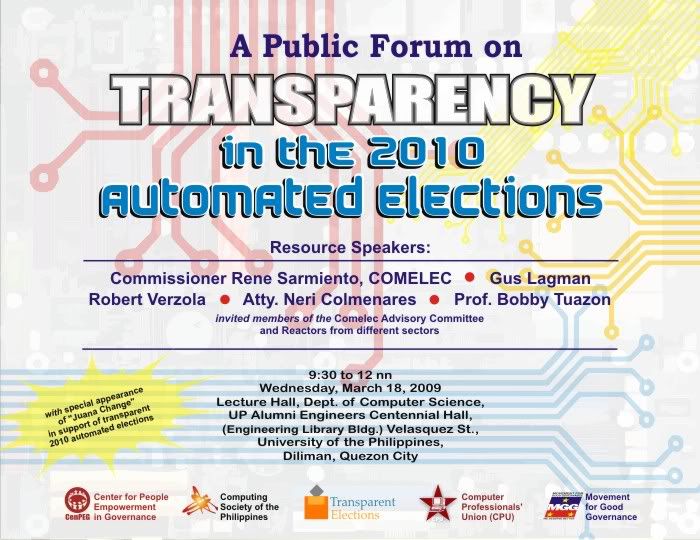
To help enlighten us on the various concerns raised about Automated Elections for the coming 2010 national and local elections, the Center for People Empowerment in Governance (CenPEG), Movement for Good Governance (MGG), Computing Society of the Philippines, (CSP) and Computer Professionals Union (CPU) would like to invite you to participate in a Public Forum to be held at 9:30a.m. to 12 noon on Wednesday, March 18, 2009 at the Lecture Hall, Department of Computer Science, UP Alumni Engineers Centennial Hall, Velasquez St. (in front of College of Science), UP Diliman, Quezon City.
Entitled “Transparency in the 2010 Automated Elections,” the forum will hear inputs and updates on the Comelec plan for the automated elections and how it hopes to address electoral issues like fraud. As a forum, we would like to devote more time to question-and-answer dialogue between the audience and the speakers.
IT specialists, poll watchers, and political analysts have also been invited to speak and/or react. A multi-sectoral audience representing the academe, people’s organizations, scientists, and other sectors are expected to join the forum.
We look forward to your invaluable presence and participation. For further inquiry or other details, please contact Forum Secretariat at Telefax number 9299526.
 The Movement for Good Governance