
Category: election reform
Press Release: Private Sector Leaders Call for Comelec Action
A multisectoral group of private sector leaders assembled today at the 24-hour prayer vigil and fasting AKKAPAKA site at Plaza Roma, Intramuros to ask for Comelec action to help improve the coming elections’ credibility.
Mano Alcuaz of the Management Association of the Philippines read the joint statement calling for a manual count signed by the Alyansa Agrikultura, the Financial Executives Institute of the Philippines, the Makati Business Club and the Philippine Bar Association. He explained the need for this new move because of the May 3 failure of the PCOS machines and the recall of the 76,300 compact flash (CF) cards just a few days before elections.
Gus Lagman, TransparentElections.org chair, argued that the 100% manual count can still be done. He said that the voting summary forms can be printed in one day. He added that Bert Lina of Air 21 has offered to deliver the forms to all municipalities within one a half days free of charge. Where the forms are not delivered, the law allows the Board of Election Inspectors to make their own emergency forms, provided they sign the vote submissions. However, if Comelec refuses to do the total manual count, then the planned random manual audit must increase its sample size from 1.5% to at least 21% to make the audit credible.
Simeon Marcelo, Philippine Bar Council President, gave the legal basis for a 100% precinct count and audit for five identified elective positions, saying this would take only an extra three hours to conduct per precinct. He identified the penalties for electoral fraud and said he would personally file charges in court against any Comelec official guilty of this.
Ernesto Ordonez, Alyansa Agrikultlura chair, talked of the danger of the canvassing center posting only the center vote total (Certificate of Canvass-COC) and not the individual precinct counts (Statement of Votes-SOV) which make up the totals. The transparency to the public needed for both the COC and SOV through projectors or other means was agreed upon after a 5-hour dialogue with Comelec officials last April 16. But so far, this has not yet been included in the Comelec’s General Instructions (G.I.’s) for canvassing centers. If this is not done immediately, the resulting lack of transparency is a sure formula for dagdag-bawas.
Leaders from the mutisectoral group then proceeded to Comelec Chair Jose Melo’s office to present their recommendations for Comelec’s immediate action.
News: If machines fail, teachers not ready for manual count
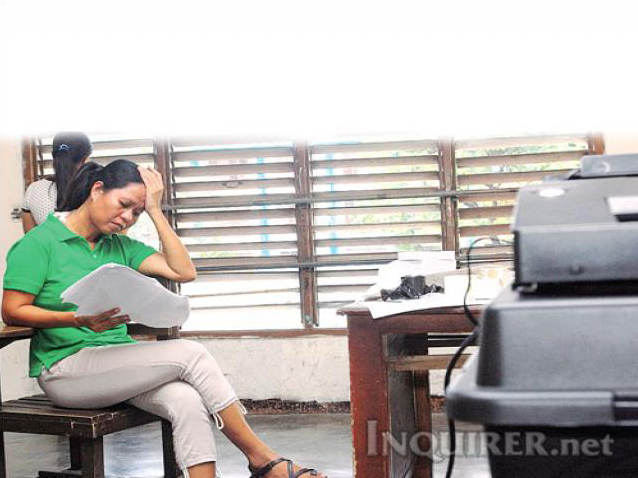 A teacher reviews the manual for a PCOS machine during a trial run Monday at Marikina High School. The device registered “thermal paper error” 20 times, forcing her and other election inspectors to ask for a replacement.
Inquirer.net: MANILA, Philippines—Teachers manning precincts on Election Day will be at a loss on what to do in case the precinct count optical scan (PCOS) machines still do not function properly.
The teachers are not prepared for manual counting, Abelardo Brutas, secretary general of the Teachers in the Philippine Public Sector (TOPPS, said.
Brutas said one of the hindrances to manual voting is the clustering of precincts. A clustered precinct could have up to a thousand voters.
Manual elections would only be possible if the Commission on Elections (Comelec) restores the original number of precincts, which is quite impossible at this time, he said.
“Definitely, we cannot handle the clustered precincts, where we have to deal with about a thousand voters per precinct,” Brutas said.
A total of 229,020 teachers is to be deployed for Monday’s elections as members of the board of election inspectors.
Even Alkhadam Sakandal, an election supervisor of Zamboanga City, acknowledged that it would be difficult for the Comelec to return to the manual process.
Too late
“Our efforts were focused on automation,” he said.
Sakandal said that even if measures were taken to adopt manual voting as a contingency measure, it was already too late with less than a week to Election Day.
“Besides, we need to appoint more BEIs (board of election inspectors) to go back to the manual process,” Sakandal said.
In Basilan, the local Church-backed watchdog group Parish Pastoral Council for Responsible Voting (PPCRV) said reverting to manual counting would be confusing.
Fr. Santiago Agoo, PPCRV chair in Isabela City, said nobody had expected the glitches to occur because both the Comelec and Smartmatic had issued assurances the machines were working fine.
The Comelec has halted the deliveries of the machines to the provinces and ordered a recall of the compact flash cards after tests showed that the names of local candidates would not be recognized by the machines.
“We didn’t expect this to happen. We are all geared up for automation and we still do not know how to go about [manual counting] if automation will not push through,” Agoo said.
He said going back to the manual process at this time “will be very tedious, very dangerous and logistics wise, we cannot cope with.”
But Education Undersecretary Franklin Sunga said the teachers were prepared to do their job in case the Comelec holds special elections in far-flung areas, or reverts to manual count.
No guidelines
The Comelec has not issued guidelines for manual counting, Sunga said.
“There are still no guidelines. There is a need for guidelines before we can proceed with this. But we cannot say that our teachers will not know what to do because there are no guidelines,” he said.
Besides, Sunga added, the counting by the PCOS machines would be automated and the election results would be electronically transmitted, saving time and avoiding ballot-snatching.
Helen Aguila-Flores, the Comelec head in Western Mindanao, however, said the agency had no alternative to automation.
“I am sorry to say this, but the Comelec has no contingency measures if automation failed,” Flores said at Thursday’s meeting of civilian, police and military officials at the headquarters of the Western Mindanao Command in Zamboanga City.
“That Comelec has no contingency plan in case automation fails is a reality that I want everyone to wake up to,” she said. “Hopefully, we can cross the bridge when we get there.”
Press Release: Comelec-Private Sector Agreement in Jeopardy
Leaders of the private sector today asked the Comelec to put guidelines in place to help ensure the credibility of the elections by fulfilling an agreement made during a five-hour dialogue they had with Comelec officials last April 16.
In a letter to Comelec Chair Jose Melo and the Comelec Commissioners, TransparentElections.org Chair Gus Lagman and Alyansa Agrikultura Chair Ernesto Ordonez asked the Comelec to fulfill an earlier agreement that would help ensure transparency and accountability at the canvassing centers during the election period.
Prior to the April 16 meeting, they had heard a plan that Comelec would mandate only the posting of the canvassing center vote totals (Certificate of Canvass-COC) without the precinct vote totals (Statement of Votes- SOV’s). Lagman said this would not allow the comparison of the vote count seen at the precinct level with the precinct vote recorded at the canvassing center. In addition, this would not allow the verification of whether the total canvassing center vote recorded had accurately included the vote count in each precinct. “Without this safeguard Comelec had earlier agreed to, we have a sure formula for dagdag-bawas,” Ordonez said.
To ensure that this agreement is implemented, the proponents recommended that the agreement’s implementation procedure should be included in the Comelec’s General Instructions (G.I.’s) for the canvassing centers. Since this has not been done, the agreement’s implementation is now severely jeopardized. The letter was submitted to the Comelec Head Office after an 11a.m. multisectoral ecumenical prayer service held during the ongoing 24 hour vigil at Plaza Roma in front of the Comelec office in Intramuros.
In an earlier letter, the proponents had stated that the 1.5% sample recommended by Comelec to be used for the manual audit was grossly inadequate. They suggested that the sample be increased to come as close as possible to the original 100% precinct audit they had originally recommended, but only for three positions. They also disagreed with the description earlier given in an official Comelec document that they were suggesting a “full parallel manual count”, when they were actually recommending that only three positions be counted, which would have take only a maximum of three extra hours to execute per precinct. They now say they are willing to decrease this number to two or one, if necessary.
Letter to Chair Melo
April 30, 2010
Chair Jose Melo
Commission on Elections
Manila
Dear Chair Melo,
We are disappointed that the Comelec has turned down our recommendation for a 100% precinct manual audit for three elective positions. We have stated earlier that we are willing to consider even just president and vice-president, or even only one position: president.
For the record, your communications refer to our proposal as “full parallel manual count”, which obviously is not the case. It is instead a 100% precinct manual audit for one to three elective positions, which is definitely not the full count.
We understand that the current audit you are contemplating has a sample of 1.5% of total precincts. We believe this is extremely inadequate, and should come as close to the 100% target as possible.
We also wish to thank Commissioner Larrazabal for his commitment that was made last April 16 at the end of our five-hour dialogue. This was that projectors will be provided in each canvassing center to show the public both the total canvassing center vote counts as well as the individual precinct counts that make up this total count.
We recommend that this be included in the general instructions to help ensure that this commitment becomes a reality.
Thank you for your consideration of this matter.
Sincerely yours,
Ernesto Ordonez
Chair, Alyansa Agrikultura
Gus Lagman
Chair, TransparentElections.org
Note: We do not like the government possibly deceiving the public by continuously saying we wanted a “full parallel manual count,” which makes our proposal sound absurd. We found out that that the promised procedure in the canvassing centers was made through a resolution to have LGU’s help implement this, and that this is not in the GI’s for the canvassing centers. This may result in non-implementation, because the Comelec may not accountable.
News: Manual count rule out today; issues cited

BusinessWorld Online: THE COMMISSION on Elections (Comelec) releases today its unanimous decision on the proposed parallel manual count for national and local positions, with officials hinting an adverse ruling.
“It is not the number of positions involved… Is it proper? Is it legal?… It is of doubtful legality,” said Comelec Chairman Jose A. R. Melo in an interview.
Comelec spokesman James Arthur B. Jimenez said in a separate interview the unanimous verdict considered the input of the commission’s field officials who will conduct the count.
For his part, Commissioner Rene V. Sarmiento said that their field officials were against the proposal due to operational and logistical concerns.
Aside from field official feedback, he said the Comelec Adivsory Council’s (CAC) opinion was also considered.
CAC member Ramon C. Casiple earlier said that the parallel manual count should be conducted by an independent body such as the National Citizens’ Movement for Free Elections (Namfrel) and not by the Comelec.
But Mr. Sarmiento said the parallel count goes against the principles of the random manual count (RMA) as provided for under the automated election law or Republic Act 9369.
“[The law] does not forbid [or] allow [parallel manual count]. [But] it goes against the principles of random manual audit… [In] parallel manual count, all would be counted. Random would be selective. The process is different,” Mr. Sarmiento said.
In a minute resolution of the full commission meeting last April 5, the poll body increased the number of precincts that would be subjected to RMA to five per legislative district from one as provided for by law.
A total of 1,145 precincts would be audited for 229 legislative districts, the resolution read.
Representatives of various groups such as the Makati Business Club (MBC), Management Association of the Philippines, Financial Executives Institute of the Philippines, Alyansa Agrikultura, Philippine Bar Association of the Philippines and information technology professionals held a dialogue with the full commission last Monday to present their proposal for the parallel manual count.
In a letter submitted to the Comelec, the groups said April 29 is the cutoff date to decide on whether or not to hold a parallel manual count.
Compromise
Meanwhile, Namfrel council member Maricor K. Akol said in a separate briefing that the group is willing to trim the positions covered by the manual count to one — the president — from three to include the vice-president and a local position.
“If they are saying that it is going to be expensive and will delay the proclamation, we are willing to bend what we are demanding and limit it to just one candidate,” she said.
Ms. Akol said the law is silent on the random parallel count of votes.
“The Comelec has argued originally that there is a legal bar in this proposal. If you recall, when they said that they used the wrong UV (ultraviolet) ink, their solution was to buy UV lamps to manually verify what was originally an automated activity. They decided on this matter without the benefit of the law. They purchased 80,000 handheld UV lamps to manually verify the ballot. This is the same principle in the parallel manual count,” Namfrel council member Guillermo M. Luz explained.
The commission, he claimed, is printing manual forms for 30% of all the precincts in case there is a failure of automated polls. “What we and the IT professionals are suggesting is for them to already print forms for 100% of the precincts for this verification run.”
The Namfrel has also called for the release of the final guidelines for the random manual audit which have been left pending at the Comelec technical committee.
“We have been asking the Comelec for the GI (general instructions) because this will be the guidelines and basis of the Board of Election Inspectors to proceed with the parallel verification run,” said Namfrel national chairman Jose L. Cuisia, Jr.
In a related development, all precinct count optical scan (PCOS) machines for Visayas and Mindanao have been shipped out from the main warehouse in Laguna province east of Metro Manila, while over half (57%) of the machines assigned for Luzon have been delivered, Comelec said.
A total of 17,077 units were sent to Visayas while 18,202 were delivered to Mindanao.
As of 10 a.m. of April 27, the official ballots deployed totaled 3,594 (21%) for Visayas and 12,936 (71%) for Mindanao.
The ballots are either in transit or have been delivered to the provinces and municipalities.
 The Movement for Good Governance