
Category: election reform
Press Release: NAMFREL expresses concern with removal of security provisions

Many safeguard provisions of election automation law are disabled or delayed
The National Citizens Movement for Free Elections or NAMFREL has once again expressed its concern over the disablement or delay or certain safeguard provisions which were originally written into the election automation law.
Wrong ultraviolet link. Among the latest issues to be disclosed by the COMELEC was the use of the wrong ultraviolet ink in the printing of the ballots to be used on May 10. Originally, ultraviolet ink was supposed to be used as a security mark on the ballot so that the automated counting machines could detect a real ballot from a fake one when ballots were fed into the machine. COMELEC belatedly disclosed that the wrong ink had been used in the printing process but only after a large number of ballots had already been printed. It has since announced that the UV sensors in the machines would be disabled but then added that Boards of Election Inspectors (BEI) would be equipped with portable, hand-held UV lights which they would use to sweep over ballots to check for the ink. The portable lights were not included in the original budget of the project and their use now adds an extra step in a new process which BEI are only beginning to learn. It is not clear how hand-held ultraviolet lights will deter ballot fraud since they will presumably detect any type of ultraviolet ink and not necessarily just the ink originally specified for the ballot printing.
Digital signatures removed. Aside from the problems with ultraviolet ink, the COMELEC has also removed a provision for digital signatures. In the original law (RA 9369), Sections 19 and 20 required that election returns and certificates of canvass be digitally signed by members of the Board of Election Inspectors. The COMELEC’s own General instructions to BEI dated December 29, 2009 (COMELEC Resolution No. 8739) required digital signatures from the BEI by inserting an iButton security key into a security key receptacle in the machine. This would presumably prevent unauthorized transmissions plus allow authorities to trace back who exactly was transmitting from specific locations and machines. The COMELEC has now removed that digital signature provision. On March 4, 2010, COMELEC released a revised General Instruction (COMELEC Resolution No. 8786) instructing BEI to forego with the digital signatures
Source code review withheld. Under the law, the COMELEC was supposed to make the source code of the technology available and open to review. Without a thorough review, it will not be possible to determine whether the various sets of instructions throughout the system correctly and accurately reflect the results and are not vulnerable to third-party instructions to introduce codes designed to manipulate vote counts or vote consolidation.
Random manual audit rules not yet out. With elections now just over 30 days away, the COMELE has yet to release its guidelines for the Random Manual Audit required by law. NAMFREL, AES, and other pollwatching groups have advocated wider coverage of the Random Manual Audit as well as its conduct prior to proclamation of winners. Given the newness of the system and the fact that it is generally untested over such a large voting population, NAMFREL and others have advocated the importance of random audits and parallel runs over significantly-sized samples, larger than that provided by law. Given numerous delays and the lifting of so many safeguards, it becomes doubly more important that a transparent audit process be pursued.
No review of back-up or disaster recovery processes. There has been, to our knowledge, no public review of the back-up or disaster recovery processes for the PCOS machines or the different levels of the canvass. If the main software or systems or any of its components fail for any reason, the back-up systems will be resorted to. These back-up systems have not been given a thorough review to check for any vulnerabilities to fraud.
Additional safeguard measures continue to remain under close watch by NAMFREL and periodic reports will be released as assessments are completed.
Electoral Risks Forum
The COALITION FOR VOTER EMPOWERMENT invites you to be part of the live studio audience of tonight’s Electoral Risks Forum!
Please confirm your attendance with Ms. Chingkel Juan at 898-3221, 898-2913, 898-2617 or 0917-8836555.
The forum will be telecast live on ANC and DZMM– the first of a series of Townhall meetings of the Coalition for Voter Empowerment which aims to empower Filipino voters with good information on the gut issues affecting them. It is crucial for voters to cast informed votes in May 2010, and the Coalition is aiming to engage the youth vote that account for 50% of the voting population.
Issues will be discussed by experts and processed with the audience in ABS-CBN studios (one in Metro Manila, two in the provinces) and candidates on TV-radio (Live on ANC and DZMM Teleradyo, with delayed telecasts in ABS-CBN’s Studio 23, and simultaneous live streaming in abs-cbnnews.com). These will be followed through on Web-based media and social networking sites (Yahoo!, YouTube, Facebook, Twitter, etc.) to help the voters get a better grip of the issues.
Date: 29 January 2010 (Friday)
Time of Forum: 8:00 PM – 9:30 PM – Live on ANC and DZMM
Call Time: 7:30 PM for Guests, 7:00 PM for Audience
Venue: Dolphy Theater, ABS-CBN, ABS-CBN Broadcasting Corporation, Sgt. Esguerra corner Mother Ignacia Sts. Quezon City
Hosts:
Ms. LYNDA JUMILLA
Mr. ANTHONY TABERNA
Mr. GERRY
Confirmed Guests: (MIX OF PANELISTS & AUDIENCE)
Atty. CHRISTIAN MONSOD
Dean RAUL PANGALANGAN
Mr. RONALD LLAMAS
Mr. DREX LAGGUI
Mr. JOEY CUISIA
Comm. GOPYO LARRAZABAL
Forum: Transparency in the 2010 Automated Elections
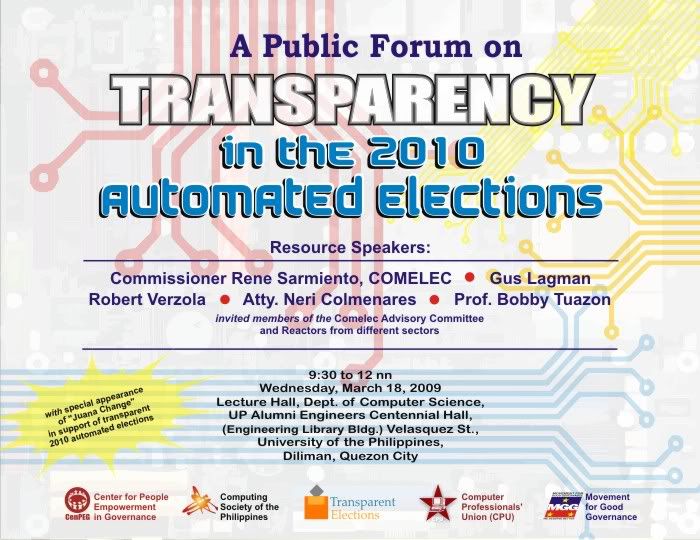
To help enlighten us on the various concerns raised about Automated Elections for the coming 2010 national and local elections, the Center for People Empowerment in Governance (CenPEG), Movement for Good Governance (MGG), Computing Society of the Philippines, (CSP) and Computer Professionals Union (CPU) would like to invite you to participate in a Public Forum to be held at 9:30a.m. to 12 noon on Wednesday, March 18, 2009 at the Lecture Hall, Department of Computer Science, UP Alumni Engineers Centennial Hall, Velasquez St. (in front of College of Science), UP Diliman, Quezon City.
Entitled “Transparency in the 2010 Automated Elections,” the forum will hear inputs and updates on the Comelec plan for the automated elections and how it hopes to address electoral issues like fraud. As a forum, we would like to devote more time to question-and-answer dialogue between the audience and the speakers.
IT specialists, poll watchers, and political analysts have also been invited to speak and/or react. A multi-sectoral audience representing the academe, people’s organizations, scientists, and other sectors are expected to join the forum.
We look forward to your invaluable presence and participation. For further inquiry or other details, please contact Forum Secretariat at Telefax number 9299526.
Press Statement: Restore the People’s Trust in the 2010 Elections
A Call for Open, Transparent, and Participatory Polls
A Joint Public Statement
For Open, Transparent, and Participatory 2010 Elections
The people’s trust and confidence in the electoral system must be brought back in the May 2010 automated polls – the first automated national and local elections in the Philippines. The only way this can be done is to make the automated elections free, open, transparent, and with full people’s participation.
We are concerned that this is not being addressed by the Commission on Elections (Comelec) through its use of the Optical Mark Reader (OMR) technology. As proven in the August 2008 ARMM elections – for that matter, in many electoral exercises in other countries – this technology is vulnerable to hacking, technical errors, delays, and other problems. And as the Comelec Advisory Council (CAC) itself admitted in a report in October 2008, the poll body is ill-equipped for the technological requirements of the coming elections.
Worse, this automated technology does not guarantee an open and transparent election. OMR uses internal tallying thus preventing voters from knowing whether their votes are counted let alone from tracking poll results through electronic transmission, canvassing, consolidation, and finally declaration of election winners. Because every step is supposed to be quick, all these will make citizens’ poll watching more taxing if not a futile exercise.
While all these months the Comelec has prioritized the procurement of automated election equipment for the 2010 polls no attention has been paid on how to address the fraud mechanisms that are still in place all over the country. The use of automated technology will come to naught unless the poll body comes up with effective measures to make these powerful fraud mechanisms irrelevant. Such fraud mechanisms will come into play – possibly with greater force and vengeance – in the coming automated polls and no amount of modern technology will ensure the coming elections to be free, honest, and democratic. It will lead to wholesale electronic cheating. Election cheats from the national to local elections will continue to be unaccountable, as usual.
While there is still time the Comelec as well as Congress should welcome other proposals aimed at making the coming elections open, transparent, and participatory. One such proposal, the Open Election System (OES) combines manual precinct-level voting and counting with automated canvassing of votes at the city/municipality, provincial, and national levels. Aside from being a lot cheaper compared to the OMR, what makes this automated technology open, transparent, and participatory is the posting of election results on a public website that will be constantly accessible to all interested parties including the voters themselves as well as poll watchers and candidates. This system opens more guarantees for the verification of election data as well as ample time for the filing of election protests against anticipated widespread irregularities.
Moreover, the OES system complies with RA 9369 which calls for “transparency, credibility, fairness, and accuracy of elections” and prescribes “the adoption and use of the most suitable technology of demonstrated capability taking into account the situation prevailing in the area and the funds available for the purpose.”
This proposed system is adaptable to Philippine conditions and promotes the voters’ right to open and participatory election. It also requires less tedious and inexpensive training for both election officials and voters – so unlike in the OMR system. Based on the Comelec calendar, the only time the public and media will know the final customized and configured OMR election system is on February 22, 2010. This leaves only two months devoted to voters’ education and scrutiny by the public on the final configuration – contrary to the CAC’s recommendation of at least six months!
Center for People Empowerment in Governance (CenPEG)
Movement for Good Governance (MGG)
Computing Society of the Phillipines (CSP)
Computer Professionals’ Union (CPU)
TransparentElections.org.ph (TE.org)
March 18, 2009
Diliman, Quezon City
News: 10M votes for good governance
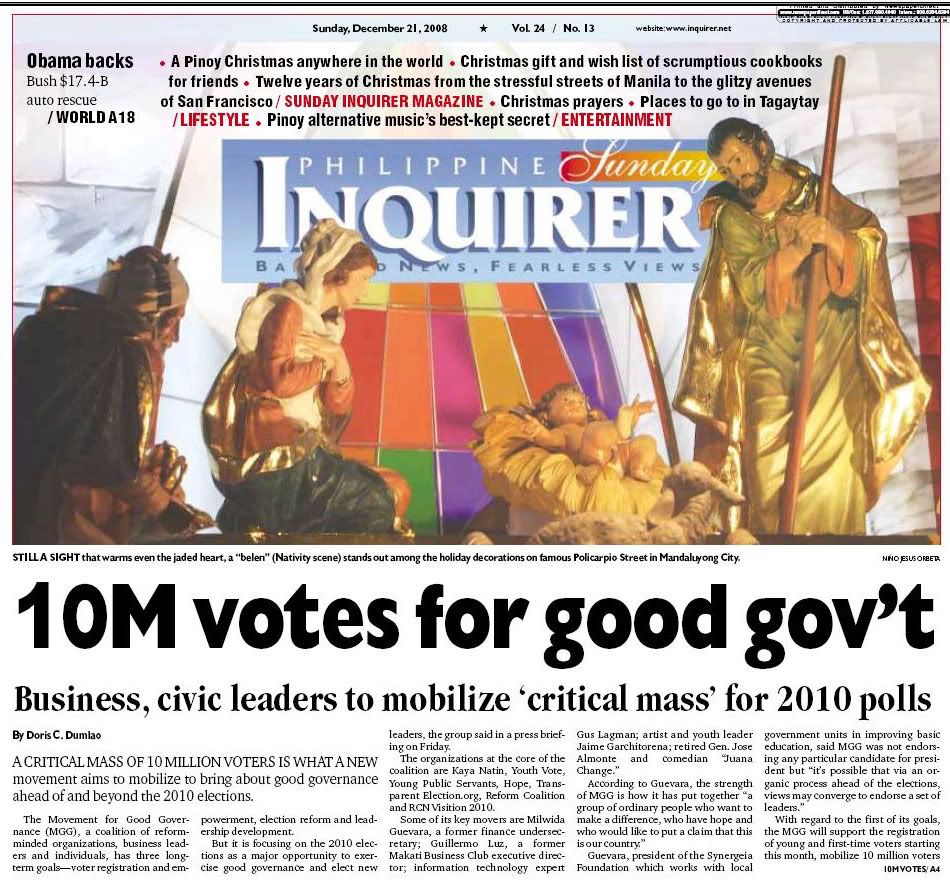
Philippine Daily Inquirer: A critical mass of 10 million voters is what a new movement aims to mobilize to bring about good governance ahead of and beyond the 2010 elections.
Movement for Good Governance (MGG), a coalition of reform-minded organizations, business leaders and individuals, has three long-term goals—voter registration and empowerment, election reform and leadership development.
But it is focusing on the 2010 elections as a major opportunity to exercise good governance and elect new leaders, the group said in a press briefing on Friday.
The organizations at the core of the coalition are Kaya Natin, Youth Vote, Young Public Servants, Hope, Transparent Election.org, Reform Coalition and RCN Visition 2010.
Some of its key movers are Milwida Guevara, a former finance undersecretary; Guillermo Luz, a former Makati Business Club executive director; information technology expert Gus Lagman; artist and youth leader Jaime Garchitorena; retired Gen. Jose Almonte and comedian “Juana Change.”
According to Guevara, the strength of MGG is how it has put together “a group of ordinary people who want to make a difference, who have hope and who would like to put a claim that this is our country.”
Guevara, president of the Synergeia Foundation which works with local government units in improving basic education, said MGG was not endorsing any particular candidate for president but “it’s possible that via an organic process ahead of the elections, views may converge to endorse a set of leaders.”
With regard to the first of its goals, the MGG will support the registration of young and first-time voters starting this month, mobilize 10 million voters to sign up and support good governance reforms and then organize communication platforms like public debates to help Filipinos understand the issues better and choose candidates wisely.
Effective automation
With respect to election reforms, MGG seeks effective automation to achieve transparent and faster canvassing of voters.
“Let’s use technology not only to prevent cheating but to make the elections more transparent,” said Lagman, of Transparent Election.org, who proposes the uploading of electoral results to the Internet after the manual canvassing of votes in the schools.
Luz said the country must fix the electoral system so that good candidates would be encouraged to run for office.
He said an online system would allow the candidates, voters, watchers the media and even the overseas Filipinos to keep track of poll results.
“Everybody will have power of information at their fingertips and that makes 40 million of us poll watchers, far better than the half a million that Namfrel can put up,” said Luz, formerly executive director of the National Movement for Free Elections.
Lagman, who was also IT chief at Namfrel, has designed a program called “Open Election System” that can speed up the canvassing of votes.
MGG seeks to encourage and empower grassroots and overseas Filipinos to monitor election results in real time and use available technology such as mobile phones and the Internet to protect the sanctity of the votes.
The coalition also seeks to guarantee the ability of overseas Filipinos to participate in and possibly influence the 2010 elections.
Direct mandate
On leadership development, MGG seeks to identify, empower and support “progressive political leaders who are sincere and effective in promoting reforms towards good governance.”
“We want to build awareness, get people to run, get good candidates to run, get people to register and get poll watchers from all walks of life,” Luz said.
Almonte, who was national security adviser to President Fidel Ramos, said that the mandate for Charter change must come directly from the people.
To ensure that any constitutional amendments would not benefit incumbent leaders, Almonte has proposed a referendum to be held simultaneously with the 2010 elections to ask the people if they wanted the Constitution amended.
If incumbent officials or those elected in 2010 would not benefit from the changes, Filipinos would likely vote “yes” in such a referendum, he said.
 The Movement for Good Governance