
Category: elections
Townhall Meeting: Talakayan 20.10 on Education

This forum aims to provide a constructive exchange between the candidates and the audience about the candidates’ position on education reform and what they intend to do to upgrade the educational system of the country.
Entrance to the event is free and all concerned citizens are invited to attend.
The Talakayan 20.10 Team is extending a special invitation to Pinoy bloggers who would like to live blog during the event. Internet access will be provided.
For further information, please send an e-mail to wedeservebetter.ph@gmail.com or a text message to 0920-9061148.
Forum: Gusto Ko Magrehistro, Gusto Kong Bumoto

The Youth Vote (Yvote) Philippines, in its commitment of getting the youth involved in the 2010 National Election will having a forum entitled “Gusto kong MAGREHISTRO, Gusto kong BUMOTO!” on Thursday, April 30, 2009, from 6:00 to 7:30 PM at AIM Conference Room, Makati City. This is part of Youth Vote’s summer registration campaign and will tackle the process of registration and issues related to it.
COMELEC Commissioner Rene Sarmiento will be present to deliver his message to the youth regarding the importance of registering for the national elections in 2010. The forum will also serve as a venue for the COMELEC and the youth to exchange concerns on registration irregularities.
Yvote Philippines will be launching Kabataang Rehistrado: 2010 headshots as part of making its registration campaign exciting yet meaningful for first time registrants. The project invites the registrants to send in actual photos of their registration. The ten best photos will then be posted at the Yvote website (www.youthvotephilippines.com) and blogsite. 10 minutes, 10 friends, 10 flyers for 2010, initiated by the Ayala Young Leaders, will also take flight on May 11, 2009 where youth volunteers will conduct distribution of “How to Register to Vote for 2010” in strategic locations such as MRT and LRT stations, shopping malls, bus stations, offices and schools. The campaign plan is to encourage 10 of your friends to dedicate 10 minutes of their time to distribute 10 flyers.
“Gusto kong MAGREHISTRO, Gusto kong BUMOTO!” forum is part of the We Deserve Better Forum series, spearheaded by the Movement for Good Governance (MGG), a group of ordinary citizens who profess their belief in transparency and accountability in governance.
Youth Vote Philippines believes in the force of the youth to make a giant leap and swing the votes in the coming 2010 elections. In order to vote, one has to REGISTER first. Youth, BE involved. Know the process and get registered. For inquiries and reservations, you may send an email to yvotephilippines@gmail.com or call 02.752.1065. The registration fee is Php 150 for young professionals and Php 50 for students.
Download the programme here.
Forum: Transparency in the 2010 Automated Elections
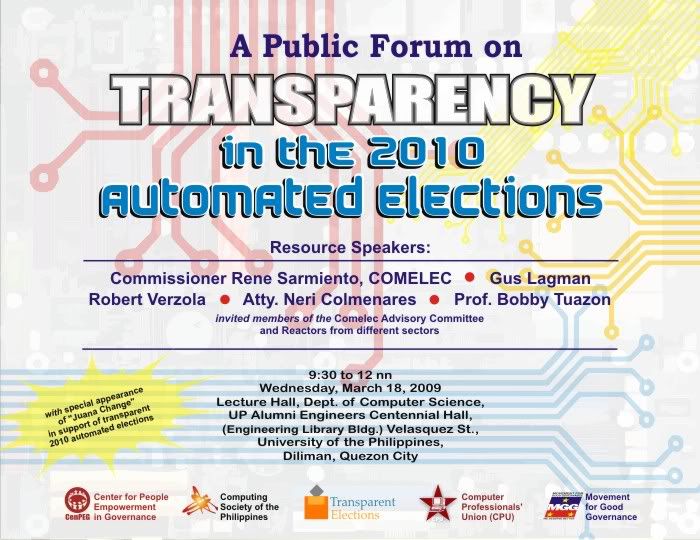
To help enlighten us on the various concerns raised about Automated Elections for the coming 2010 national and local elections, the Center for People Empowerment in Governance (CenPEG), Movement for Good Governance (MGG), Computing Society of the Philippines, (CSP) and Computer Professionals Union (CPU) would like to invite you to participate in a Public Forum to be held at 9:30a.m. to 12 noon on Wednesday, March 18, 2009 at the Lecture Hall, Department of Computer Science, UP Alumni Engineers Centennial Hall, Velasquez St. (in front of College of Science), UP Diliman, Quezon City.
Entitled “Transparency in the 2010 Automated Elections,” the forum will hear inputs and updates on the Comelec plan for the automated elections and how it hopes to address electoral issues like fraud. As a forum, we would like to devote more time to question-and-answer dialogue between the audience and the speakers.
IT specialists, poll watchers, and political analysts have also been invited to speak and/or react. A multi-sectoral audience representing the academe, people’s organizations, scientists, and other sectors are expected to join the forum.
We look forward to your invaluable presence and participation. For further inquiry or other details, please contact Forum Secretariat at Telefax number 9299526.
Press Statement: Restore the People’s Trust in the 2010 Elections
A Call for Open, Transparent, and Participatory Polls
A Joint Public Statement
For Open, Transparent, and Participatory 2010 Elections
The people’s trust and confidence in the electoral system must be brought back in the May 2010 automated polls – the first automated national and local elections in the Philippines. The only way this can be done is to make the automated elections free, open, transparent, and with full people’s participation.
We are concerned that this is not being addressed by the Commission on Elections (Comelec) through its use of the Optical Mark Reader (OMR) technology. As proven in the August 2008 ARMM elections – for that matter, in many electoral exercises in other countries – this technology is vulnerable to hacking, technical errors, delays, and other problems. And as the Comelec Advisory Council (CAC) itself admitted in a report in October 2008, the poll body is ill-equipped for the technological requirements of the coming elections.
Worse, this automated technology does not guarantee an open and transparent election. OMR uses internal tallying thus preventing voters from knowing whether their votes are counted let alone from tracking poll results through electronic transmission, canvassing, consolidation, and finally declaration of election winners. Because every step is supposed to be quick, all these will make citizens’ poll watching more taxing if not a futile exercise.
While all these months the Comelec has prioritized the procurement of automated election equipment for the 2010 polls no attention has been paid on how to address the fraud mechanisms that are still in place all over the country. The use of automated technology will come to naught unless the poll body comes up with effective measures to make these powerful fraud mechanisms irrelevant. Such fraud mechanisms will come into play – possibly with greater force and vengeance – in the coming automated polls and no amount of modern technology will ensure the coming elections to be free, honest, and democratic. It will lead to wholesale electronic cheating. Election cheats from the national to local elections will continue to be unaccountable, as usual.
While there is still time the Comelec as well as Congress should welcome other proposals aimed at making the coming elections open, transparent, and participatory. One such proposal, the Open Election System (OES) combines manual precinct-level voting and counting with automated canvassing of votes at the city/municipality, provincial, and national levels. Aside from being a lot cheaper compared to the OMR, what makes this automated technology open, transparent, and participatory is the posting of election results on a public website that will be constantly accessible to all interested parties including the voters themselves as well as poll watchers and candidates. This system opens more guarantees for the verification of election data as well as ample time for the filing of election protests against anticipated widespread irregularities.
Moreover, the OES system complies with RA 9369 which calls for “transparency, credibility, fairness, and accuracy of elections” and prescribes “the adoption and use of the most suitable technology of demonstrated capability taking into account the situation prevailing in the area and the funds available for the purpose.”
This proposed system is adaptable to Philippine conditions and promotes the voters’ right to open and participatory election. It also requires less tedious and inexpensive training for both election officials and voters – so unlike in the OMR system. Based on the Comelec calendar, the only time the public and media will know the final customized and configured OMR election system is on February 22, 2010. This leaves only two months devoted to voters’ education and scrutiny by the public on the final configuration – contrary to the CAC’s recommendation of at least six months!
Center for People Empowerment in Governance (CenPEG)
Movement for Good Governance (MGG)
Computing Society of the Phillipines (CSP)
Computer Professionals’ Union (CPU)
TransparentElections.org.ph (TE.org)
March 18, 2009
Diliman, Quezon City
News: Wanted: 10 million voters in support of “a gov’t we deserve”
Abs-cbnNEWS.com/Newsbreak: A new movement in search of 10 million voters who will support reform-oriented, pro-good governance candidates in next year’s May national and local elections was formally launched February 3.
At least 300 citizens–professionals, workers, urban poor, youths, former government officials–met at Robinsons Galleria Tuesday evening for the official launch of the Movement for Good Governance (MGG).
“We are looking for 10 million Filipinos who will elect in 2010 a new government we deserve,” declared former Finance Undersecretary Milwida Guevara, chief executive officer of Synergeia Inc., an NGO working to improve access to basic education.
In an interview with abs-cbnNEWS.com/Newsbreak, Guevara said the MGG seeks to “enable people to come together so that we can have 10 million votes to support good candidates” in next year’s elections.
‘Juana Change’ on YouTube
The seeds of the MGG social marketing campaign were actually planted last year with the launching on YouTube of four videos of “Juana Change,” a character played by actress Mae Paner. The short clips seek to promote love of country, fight corruption, and promote good citizenship.
Three new short videos were premiered that evening at Indiesine, Robinsons Galleria’s cinema for independent films, which also served as a fund-raising activity for the MGG.
Paner, who has appeared in some TV commercials, was the star at the launch. Wearing a small garterized umbrella on her head, a “Juana Change” T-shirt, and red pants, she asked the audience: “Juana Change (Wanna change)?…. Ang sagot, Juana Change din (The answer is also wanna change).”
She said the videos were produced free of charge by concerned citizens of the Convergence Team, which includes scriptwriter Rody Vera and director Sockie Fernandez.
“We in the Convergence Team are part of the MGG. Our goal is to serve the country. Our objectives cannot be achieved by just one brave person. We need many brave citizens. If we are many, then we can do a lot in 2010,” she said.
From virals to grassroots
Susan Quimpo, a member of the team, said it was time to shift the MGG’s campaign from the virals to the grassroots. As Paner told the audience at the premiere night, “We want to go national, we don’t want to be just in YouTube.”
Paner said she initially thought that the Juana Change scripts were too harsh, but scriptwriter Vera told her they merely convey the “truth” about what’s happening in the Philippines.
The key messages of the first four videos are:
She said the sharing of the videos has been able to generate interest in a movement for change, but it needs more supporters and funding.
“We’re glad with the result of Juana Change. Because you’ve forwarded the videos, they’re being discussed, and so there are many of us here today,” she said. “We want to continue but we need your help.”
“Juana Change is one of the stalwarts of the MGG,” said Guevara. “We use satire, all forms of strategies to be able to drive home the message that we deserve better.”
Multi-level marketing
Ricky Xavier of the Movement for HOPE, said the MGG’s goal is to “recruit, unite, and organize people and groups in order to build up 10 million supporters who will elect candidates of integrity and competence.”
He said the campaign will use a “multi-level marketing approach” where each new recruit will be asked to bring in 10 other individuals to the MGG.
“If NAMFREL [National Movement for Free Elections] had 500,000 volunteers in 1986, our goal is one million volunteer-citizens by November 2009. This will significantly affect the results of the election,” Xavier said. “We believe that together, and with divine help, we can change the kind of political leadership and governance we’ve had because we deserve better.”
New technologies
Antonio La Viña, dean of the Ateneo School of Government, told abs-cbnNEWS.com/Newsbreak that one of the challenges of the MGG is how to translate their ideas into action.
“The challenge is to work hard. Having the right motivation, having faith in the people is a good thing, but you have to translate that into action,” he said.
“I don’t think the problem is whether the persons are there, but whether we’re able to translate this urge for change, this desire for change into an organization and into numbers. So I’m not saying it will happen because it’s going to take a lot of hard work,” La Viña said.
However, he said that with new technologies like the internet and mobile phones, it’s much easier now to get people to support a cause.
“And the one thing that wasn’t there in past efforts was technology to connect people to each other. Before, it was very expensive to organize all over the Philippines. Now, with one video, you can get people to come together,” he said, noting that mobile phone ownership has spread to the grassroots.
“It’s a first effort to try to really use technology to reach as many people. Our goal is 10 million voters by end of December, which we can say is a reform vote,” he added.
 The Movement for Good Governance