
Category: news
News: Group to select candidates for 2010 via “people’s primaries”
MB.com.ph: Inspired by the outcome of a community-based selection process in choosing candidates for national positions during the recent election in the United States, a multi-sector group is set to implement “The Primary System” aimed at reforming Philippine politics by giving equal chances of winning for non-traditional politicians versus traditional politicos in the May 2010 polls.
Ricky Xavier of the Movement for Good Governance (MGG) said during a forum at the Asian Institute of Management (AIM) that they have started preparing since last December for what they call “The People’s Primaries,” a selection process that will encourage communities to identify and consider new leaders for next year’s electoral exercise.
“Today our political situation is similar to that of the United States when at the turn of the 20th Century they adopted the Primary System. At this stage of our history, we need to retool our democracy so we can fix our corrupt political system,” Xavier said.
“Things have changed, a greater majority of our voters are better informed of the issues, and the youth have access to more and better sources of information. While we do not have a two party system, there is a clear demarcation line been the “Trapo” and “Non-trapo” politicians in their political parties,” he said.
Xavier said they were inspired by the intentions of reform-oriented non-traditional personalities like Pampanga Gov. Ed Panlilio, Isabela Gov. Grace Padaca, environmentalist Nicky Perlas, rebel officer Army Brig. Gen Danilo Lim of eyeing elective posts to pursue changes in the country’s political system that has been dominated by a few oligarchs.
Several non-government organizations that included Subsidiarity Movement, Green Convergence, Partidong Pandaigdigan Pilipino, Magnificat Movement, Global Filipino Network, Movement for Hope and Jesus is Lord Movement participated in the “People’s Primaries” conference.
Archbishop Angel N. Lagdameo, Catholic Bishop’s Conference of the Philippines (CBCP) along with philanthropist Gina Lopez of the ABS-CBN Foundation have expressed his support to the “People’s Primaries.”
According to Lawyer Philip Camara of the Magnificat Movement, the “People’s Primaries” is district-based involving one-person, one vote system that will be tallied through a computerized SMS-vote tallying system.
Using the existing 216 congressional districts all over the country, the “People’s Primaries” will organize district chapters in each of those areas for the implementation of the District Electoral Voting (DEV).
The People’s Primaries is aiming to mobilize at least 20 percent of the electorate per congressional district. In the DEV, one member, one vote is reconciled at the district level through the SMS with the corresponding control number issued by the National Facilitators Group (NFG) that will prevent possible fraud and manipulation.
The national winner in the People’s Primaries is the candidate with the highest electoral votes garnered.
The MGG expressed optimism that the People’s Primaries will be able to come up with a “People’s Dream Team” led by a single yet strong non-traditional candidate for the presidential post for the May 2010 polls before the deadline set by the Commission on Elections for the filing of candidacy for candidates on November this year.
News: Wanted: 10 million voters in support of “a gov’t we deserve”
Abs-cbnNEWS.com/Newsbreak: A new movement in search of 10 million voters who will support reform-oriented, pro-good governance candidates in next year’s May national and local elections was formally launched February 3.
At least 300 citizens–professionals, workers, urban poor, youths, former government officials–met at Robinsons Galleria Tuesday evening for the official launch of the Movement for Good Governance (MGG).
“We are looking for 10 million Filipinos who will elect in 2010 a new government we deserve,” declared former Finance Undersecretary Milwida Guevara, chief executive officer of Synergeia Inc., an NGO working to improve access to basic education.
In an interview with abs-cbnNEWS.com/Newsbreak, Guevara said the MGG seeks to “enable people to come together so that we can have 10 million votes to support good candidates” in next year’s elections.
‘Juana Change’ on YouTube
The seeds of the MGG social marketing campaign were actually planted last year with the launching on YouTube of four videos of “Juana Change,” a character played by actress Mae Paner. The short clips seek to promote love of country, fight corruption, and promote good citizenship.
Three new short videos were premiered that evening at Indiesine, Robinsons Galleria’s cinema for independent films, which also served as a fund-raising activity for the MGG.
Paner, who has appeared in some TV commercials, was the star at the launch. Wearing a small garterized umbrella on her head, a “Juana Change” T-shirt, and red pants, she asked the audience: “Juana Change (Wanna change)?…. Ang sagot, Juana Change din (The answer is also wanna change).”
She said the videos were produced free of charge by concerned citizens of the Convergence Team, which includes scriptwriter Rody Vera and director Sockie Fernandez.
“We in the Convergence Team are part of the MGG. Our goal is to serve the country. Our objectives cannot be achieved by just one brave person. We need many brave citizens. If we are many, then we can do a lot in 2010,” she said.
From virals to grassroots
Susan Quimpo, a member of the team, said it was time to shift the MGG’s campaign from the virals to the grassroots. As Paner told the audience at the premiere night, “We want to go national, we don’t want to be just in YouTube.”
Paner said she initially thought that the Juana Change scripts were too harsh, but scriptwriter Vera told her they merely convey the “truth” about what’s happening in the Philippines.
The key messages of the first four videos are:
She said the sharing of the videos has been able to generate interest in a movement for change, but it needs more supporters and funding.
“We’re glad with the result of Juana Change. Because you’ve forwarded the videos, they’re being discussed, and so there are many of us here today,” she said. “We want to continue but we need your help.”
“Juana Change is one of the stalwarts of the MGG,” said Guevara. “We use satire, all forms of strategies to be able to drive home the message that we deserve better.”
Multi-level marketing
Ricky Xavier of the Movement for HOPE, said the MGG’s goal is to “recruit, unite, and organize people and groups in order to build up 10 million supporters who will elect candidates of integrity and competence.”
He said the campaign will use a “multi-level marketing approach” where each new recruit will be asked to bring in 10 other individuals to the MGG.
“If NAMFREL [National Movement for Free Elections] had 500,000 volunteers in 1986, our goal is one million volunteer-citizens by November 2009. This will significantly affect the results of the election,” Xavier said. “We believe that together, and with divine help, we can change the kind of political leadership and governance we’ve had because we deserve better.”
New technologies
Antonio La Viña, dean of the Ateneo School of Government, told abs-cbnNEWS.com/Newsbreak that one of the challenges of the MGG is how to translate their ideas into action.
“The challenge is to work hard. Having the right motivation, having faith in the people is a good thing, but you have to translate that into action,” he said.
“I don’t think the problem is whether the persons are there, but whether we’re able to translate this urge for change, this desire for change into an organization and into numbers. So I’m not saying it will happen because it’s going to take a lot of hard work,” La Viña said.
However, he said that with new technologies like the internet and mobile phones, it’s much easier now to get people to support a cause.
“And the one thing that wasn’t there in past efforts was technology to connect people to each other. Before, it was very expensive to organize all over the Philippines. Now, with one video, you can get people to come together,” he said, noting that mobile phone ownership has spread to the grassroots.
“It’s a first effort to try to really use technology to reach as many people. Our goal is 10 million voters by end of December, which we can say is a reform vote,” he added.
News: Mariano: “Overcoming apathy the biggest challenge”
Abs-cbnNEWS.com/Newsbreak: In 2004, Darwin Mariano was an Aksyon Demokratiko youth leader for then presidential candidate Raul Roco. Today, he subsists by working for the corporate social unit of a cement firm. After work, he devotes his time and energy to the Movement for Good Governance (MGG), a new group seeking to build a 10-million constituency of voters who will choose competent candidates advocating the cause of reforming government. Abs-cbnNEWS.com/Newsbreak had a chat with him last February 3 at the launching of the MGG.
Q. What’s the difference between MGG and other groups seeking reforms?
A. I think it’s the timing. For the first time, people genuinely feel that short cuts no longer work, and that real substantive change has to come from ordinary people, groups from all areas, all sectors, all areas of the country, coming together to work on the things that we agree on, the things that we have in common, the goals that we have in common rather than focus on the things that make us different.
The KRAs [Key Result Areas] are very simple, and which is why I think it’s also different and why it’s potentially very powerful: 10 million people who will sign up and commit to helping reform-oriented candidates, candidates who agree to debate and defend their record and be judged against a clear criteria. And then an election process wherein the results at the precinct level are made public so that you prevent or deter those who want to cheat at the canvassing. So very easy, so I think it’s easy for people to come together and rally around a movement whose objective is clear.
Q. What is your biggest challenge?
A. I think overcoming apathy. The people who are here are people who have never given up hope. Unfortunately, I think that’s not always true, and I think what you only need to do is to show people, bring them in to connect and contact with others who have not given up hope and they rediscover the hope that they have in themselves.
Q. It would seem from this small gathering that you have not reached a critical mass?
A. Yes, that’s why we keep pushing. It’s hardest at this stage where you’re pushing, when you’re starting. But we’re far bigger now than when we started. There’s no one history, no one past to the organization. At the end of the day, it’s still a fight worth fighting. It’s a journey worth taking for everyone.
Q. It would seem the MGG still lacks the support of the masses?
A. No, there are many youth organizations. We’re already starting to build a group in the urban poor. I think what’s important is to get the support of the middle class because they will provide the resources, manpower, money to help bankroll the broad campaign needed for change. Without the middle classes’ support, mahihirapan tayo, and that’s what we’re trying to attract people with activities like this.
Q. In 2004, you were a youth leader for Raul Roco’s Aksyon Demokratiko. What’s the difference between being a partisan campaigner and helping the MGG?
A. I’m doing this in my personal capacity. I think it’s easier to get people to support it because it’s not personality-based. I’m not selling a candidate, I’m selling an idea. And in fact, it’s an improvement also from the type of politics that you want to support, from a personality-centered politics. No matter how qualified the candidate is, you’re trying to rally everyone to support ideas, to support advocacies. Hopefully, in the process, you move everyone.
News: 10M votes for good governance
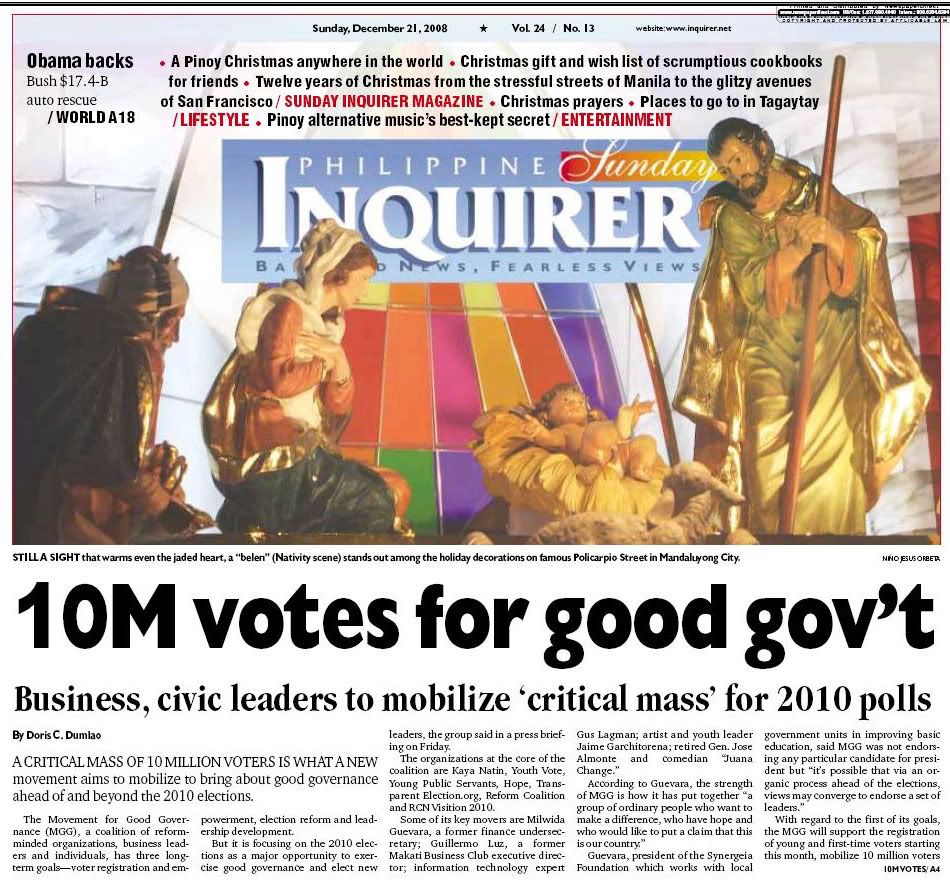
Philippine Daily Inquirer: A critical mass of 10 million voters is what a new movement aims to mobilize to bring about good governance ahead of and beyond the 2010 elections.
Movement for Good Governance (MGG), a coalition of reform-minded organizations, business leaders and individuals, has three long-term goals—voter registration and empowerment, election reform and leadership development.
But it is focusing on the 2010 elections as a major opportunity to exercise good governance and elect new leaders, the group said in a press briefing on Friday.
The organizations at the core of the coalition are Kaya Natin, Youth Vote, Young Public Servants, Hope, Transparent Election.org, Reform Coalition and RCN Visition 2010.
Some of its key movers are Milwida Guevara, a former finance undersecretary; Guillermo Luz, a former Makati Business Club executive director; information technology expert Gus Lagman; artist and youth leader Jaime Garchitorena; retired Gen. Jose Almonte and comedian “Juana Change.”
According to Guevara, the strength of MGG is how it has put together “a group of ordinary people who want to make a difference, who have hope and who would like to put a claim that this is our country.”
Guevara, president of the Synergeia Foundation which works with local government units in improving basic education, said MGG was not endorsing any particular candidate for president but “it’s possible that via an organic process ahead of the elections, views may converge to endorse a set of leaders.”
With regard to the first of its goals, the MGG will support the registration of young and first-time voters starting this month, mobilize 10 million voters to sign up and support good governance reforms and then organize communication platforms like public debates to help Filipinos understand the issues better and choose candidates wisely.
Effective automation
With respect to election reforms, MGG seeks effective automation to achieve transparent and faster canvassing of voters.
“Let’s use technology not only to prevent cheating but to make the elections more transparent,” said Lagman, of Transparent Election.org, who proposes the uploading of electoral results to the Internet after the manual canvassing of votes in the schools.
Luz said the country must fix the electoral system so that good candidates would be encouraged to run for office.
He said an online system would allow the candidates, voters, watchers the media and even the overseas Filipinos to keep track of poll results.
“Everybody will have power of information at their fingertips and that makes 40 million of us poll watchers, far better than the half a million that Namfrel can put up,” said Luz, formerly executive director of the National Movement for Free Elections.
Lagman, who was also IT chief at Namfrel, has designed a program called “Open Election System” that can speed up the canvassing of votes.
MGG seeks to encourage and empower grassroots and overseas Filipinos to monitor election results in real time and use available technology such as mobile phones and the Internet to protect the sanctity of the votes.
The coalition also seeks to guarantee the ability of overseas Filipinos to participate in and possibly influence the 2010 elections.
Direct mandate
On leadership development, MGG seeks to identify, empower and support “progressive political leaders who are sincere and effective in promoting reforms towards good governance.”
“We want to build awareness, get people to run, get good candidates to run, get people to register and get poll watchers from all walks of life,” Luz said.
Almonte, who was national security adviser to President Fidel Ramos, said that the mandate for Charter change must come directly from the people.
To ensure that any constitutional amendments would not benefit incumbent leaders, Almonte has proposed a referendum to be held simultaneously with the 2010 elections to ask the people if they wanted the Constitution amended.
If incumbent officials or those elected in 2010 would not benefit from the changes, Filipinos would likely vote “yes” in such a referendum, he said.
 The Movement for Good Governance