
How trustworthy is the random manual audit (RMA)?

YouthVotePhilippines: With the technical glitches in yesterday’s first automated polls, the random manual audit (RMA) becomes more crucial in ensuring the credibility of election results.

The Commission on Elections has released Resolution 8837 on the conduct of the RMA after rejecting calls from various groups to conduct a parallel manual count last April 29.

In particular, while the resolution provides for the composition and duties of the RMA team (RMAT) and the general instructions of conducting the audit, the acceptable margin of variance between the Precinct Count Optical Scan (PCOS) count and the audit count remains uncertain.

“It’s crucial that we first determine what’s the acceptable tolerance for error between the automated and manual counts, before we conduct any form of audit,” said Jaime Garchitorena, YouthVotePhilippines information technology strategist.

“What if there is a variance but it’s not that significant to the results? We can’t decide which variance to accept after the fact. We should have clear rules on that even before voting begins,” he said.

Issue still about trust

Based on the proposal of the Parish Pastoral Council for Responsible Voting (PPCRV), the RMA will be done immediately upon the close of elections in five clustered precincts for each of the 229 congressional districts.

RMATs will be deployed in polling precincts randomly selected using a tambiolo with numbered balls. The audit will be conducted in 1,145 clustered precincts nationwide once the PCOS machines have been shut down.

The positions that will be manually counted for the audit include the president, vice president, district representative, governor and mayor.

The National Citizens’ Movement for Free Elections (Namfrel), however, earlier recommended that the RMA cover 5 percent of all PCOS machines per congressional district instead of just five clustered precincts. Originally, Comelec only planned for an audit of one machine per district.

It also suggested that “the audit process should include a review of the hash codes of the PCOS machines for comparison with source codes stored in Bangko Sentral (Central Bank).”

Despite Comelec’s non-accreditation, Namfrel still plans to conduct its own parallel count to ensure credible elections. It said in a statement, “Both the manual and automated counts should be made available immediately to the public for transparency purposes.”

In his column in the Philippine Daily Inquirer last February, Social Weather Stations president Mahar Mangahas wrote that former ambassador Henrietta de Villa of PPCRV had approached him to become a guest consultant, pro bono, in the RMA technical working group which met in November 2009.

Mangahas said the RMA process will have scientific meaning only if its individual audits are completely trustworthy.

“The question of how many PCOS machines to audit cannot even be addressed by statistical principles unless integrity is assured for each and every audit,” he said.

“If trust is the issue then it cuts both ways. To be objective about it, if you don’t trust the Comelec the same skepticism should apply to groups conducting the audit,” Garchitorena said.

“In more concrete terms, any person who offers to handle my ballot physically should be someone I trust completely,” he added.

To remove any suspicion of vested interest, Garchitorena suggested in a public call last month that all proponents of any manual count or audit be named and made to promise to decline any offer to sit in the next government at least for the next three years.

“Even the auditors should be kept in check,” he said. “How would it look if an auditor was found to have an unexplained sum of money in his account after proclaiming a winner in a controversial local election? In something as critical as this, it’s important to their credibility that they will not personally benefit from the activity.”

Cheating the audit improbable

Some groups and local candidates have expressed fears that excess ballots may be used for cheating the audit, but Comelec spokesperson James Jimenez said there is “no opportunity to insert unused ballots” into the machine.

The number of ballots per clustered precinct matches the number of voters in the precinct’s list.

“Kasama sa procedure natin ay ina-announce ng BEI (Board of Election Inspectors) na meron syang unused ballots, kasi gugupitin nya yun pagkatapos (It’s part of the procedure for the BEI to announce that there are unused ballots, because they will cut it in half after the voting period ends),” he said.

Audit rules state that in case the number of ballots that will be subjected to the audit exceeds the number of votes found in the Minutes of Voting and Counting certified by the BEI, the resolution requires for an investigation for “any possible reasons” of the discrepancy, such as spoiled or rejected ballots.

But in the event that no probable reason is identified, “all the ballots shall be returned in the ballot box and thoroughly mixed by the (Board of Election Inspectors) Chairman.” The BEI chair will then “randomly take out from the ballot box the number of ballots equal to the excess and place them in the RMA envelopes for excess ballots.”

“Without a clear acceptable level of variance, a situation where this happens can cause commotion if because of the random pick of ballots to be counted, the audit count differs by some margin with the PCOS count,” Garchitorena said.

Proclamation not affected by audit

With Comelec’s rejection of a parallel manual count, Namfrel has suggested for an audit of votes before the results are transmitted. Several groups have also expressed opposition to proclaiming candidates as winners, especially in local posts, before a manual tally confirms the PCOS count.

Jimenez, however, said while the audit results will not affect proclamation, they can be used as grounds to file an election protest. “Pwedeng gamitin yun bilang grounds to challenge proclamation (Audit results can be used as grounds to challenge proclamation),” he said. “Kasi malinaw naman, meron na kagad colorable doubt, na mukha talagang may nangyaring mali (Because then it would be clear that something went wrong and that would cause doubt).”

“But of course that will trigger yung sinasabi nating (what we call) discovery of root causes,” he said.

Comelec has been firm that results of the audit should not hinder the proclamation of winning candidates based on the PCOS count.

Garchitorena agreed with proclaiming without the audit results. He said that if audit or manual count results are given much weight without a clear provision on an acceptable discrepancy when compared to the PCOS count, “we’re setting up a no proclamation scenario.”

“Especially since no one is really pushing for clarifications on the constitutional engine that searches for a leader in the absence of duly elected officials or electoral power vacuum,” he said.

Garchitorena, however, cautioned the Comelec from comparing the ease of using the Automated Teller Machine (ATM) with the automated election system (AES) to illustrate its reliability.

“ATM machines still fail today. The key to accepting the ATM was the stability and trust in the banks which operate the machines,” he said. “People know that their money is safe and that if there is a discrepancy in their receipt and what they got, they can complain.”

Instead of saying the machine will run perfectly, Garchitorena said the Comelec should explain that the improvement of the AES comes with the constant use and adjustment of the PCOS machines, including successful testing.
Press Release: Private Sector Leaders Call for Comelec Action

A multisectoral group of private sector leaders assembled today at the 24-hour prayer vigil and fasting AKKAPAKA site at Plaza Roma, Intramuros to ask for Comelec action to help improve the coming elections’ credibility.

Mano Alcuaz of the Management Association of the Philippines read the joint statement calling for a manual count signed by the Alyansa Agrikultura, the Financial Executives Institute of the Philippines, the Makati Business Club and the Philippine Bar Association. He explained the need for this new move because of the May 3 failure of the PCOS machines and the recall of the 76,300 compact flash (CF) cards just a few days before elections.

Gus Lagman, TransparentElections.org chair, argued that the 100% manual count can still be done. He said that the voting summary forms can be printed in one day. He added that Bert Lina of Air 21 has offered to deliver the forms to all municipalities within one a half days free of charge. Where the forms are not delivered, the law allows the Board of Election Inspectors to make their own emergency forms, provided they sign the vote submissions. However, if Comelec refuses to do the total manual count, then the planned random manual audit must increase its sample size from 1.5% to at least 21% to make the audit credible.

Simeon Marcelo, Philippine Bar Council President, gave the legal basis for a 100% precinct count and audit for five identified elective positions, saying this would take only an extra three hours to conduct per precinct. He identified the penalties for electoral fraud and said he would personally file charges in court against any Comelec official guilty of this.

Ernesto Ordonez, Alyansa Agrikultlura chair, talked of the danger of the canvassing center posting only the center vote total (Certificate of Canvass-COC) and not the individual precinct counts (Statement of Votes-SOV) which make up the totals. The transparency to the public needed for both the COC and SOV through projectors or other means was agreed upon after a 5-hour dialogue with Comelec officials last April 16. But so far, this has not yet been included in the Comelec’s General Instructions (G.I.’s) for canvassing centers. If this is not done immediately, the resulting lack of transparency is a sure formula for dagdag-bawas.

Leaders from the mutisectoral group then proceeded to Comelec Chair Jose Melo’s office to present their recommendations for Comelec’s immediate action.

News: If machines fail, teachers not ready for manual count

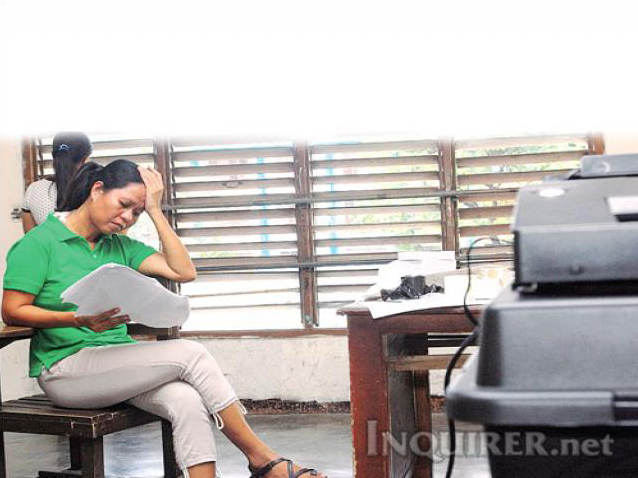
A teacher reviews the manual for a PCOS machine during a trial run Monday at Marikina High School. The device registered “thermal paper error” 20 times, forcing her and other election inspectors to ask for a replacement.

Inquirer.net: MANILA, Philippines—Teachers manning precincts on Election Day will be at a loss on what to do in case the precinct count optical scan (PCOS) machines still do not function properly.

The teachers are not prepared for manual counting, Abelardo Brutas, secretary general of the Teachers in the Philippine Public Sector (TOPPS, said.

Brutas said one of the hindrances to manual voting is the clustering of precincts. A clustered precinct could have up to a thousand voters.

Manual elections would only be possible if the Commission on Elections (Comelec) restores the original number of precincts, which is quite impossible at this time, he said.

“Definitely, we cannot handle the clustered precincts, where we have to deal with about a thousand voters per precinct,” Brutas said.

A total of 229,020 teachers is to be deployed for Monday’s elections as members of the board of election inspectors.

Even Alkhadam Sakandal, an election supervisor of Zamboanga City, acknowledged that it would be difficult for the Comelec to return to the manual process.

Too late

“Our efforts were focused on automation,” he said.

Sakandal said that even if measures were taken to adopt manual voting as a contingency measure, it was already too late with less than a week to Election Day.

“Besides, we need to appoint more BEIs (board of election inspectors) to go back to the manual process,” Sakandal said.

In Basilan, the local Church-backed watchdog group Parish Pastoral Council for Responsible Voting (PPCRV) said reverting to manual counting would be confusing.

Fr. Santiago Agoo, PPCRV chair in Isabela City, said nobody had expected the glitches to occur because both the Comelec and Smartmatic had issued assurances the machines were working fine.

The Comelec has halted the deliveries of the machines to the provinces and ordered a recall of the compact flash cards after tests showed that the names of local candidates would not be recognized by the machines.

“We didn’t expect this to happen. We are all geared up for automation and we still do not know how to go about [manual counting] if automation will not push through,” Agoo said.

He said going back to the manual process at this time “will be very tedious, very dangerous and logistics wise, we cannot cope with.”

But Education Undersecretary Franklin Sunga said the teachers were prepared to do their job in case the Comelec holds special elections in far-flung areas, or reverts to manual count.

No guidelines

The Comelec has not issued guidelines for manual counting, Sunga said.

“There are still no guidelines. There is a need for guidelines before we can proceed with this. But we cannot say that our teachers will not know what to do because there are no guidelines,” he said.

Besides, Sunga added, the counting by the PCOS machines would be automated and the election results would be electronically transmitted, saving time and avoiding ballot-snatching.

Helen Aguila-Flores, the Comelec head in Western Mindanao, however, said the agency had no alternative to automation.

“I am sorry to say this, but the Comelec has no contingency measures if automation failed,” Flores said at Thursday’s meeting of civilian, police and military officials at the headquarters of the Western Mindanao Command in Zamboanga City.

“That Comelec has no contingency plan in case automation fails is a reality that I want everyone to wake up to,” she said. “Hopefully, we can cross the bridge when we get there.”

Press Release: Comelec-Private Sector Agreement in Jeopardy

Leaders of the private sector today asked the Comelec to put guidelines in place to help ensure the credibility of the elections by fulfilling an agreement made during a five-hour dialogue they had with Comelec officials last April 16.

In a letter to Comelec Chair Jose Melo and the Comelec Commissioners, TransparentElections.org Chair Gus Lagman and Alyansa Agrikultura Chair Ernesto Ordonez asked the Comelec to fulfill an earlier agreement that would help ensure transparency and accountability at the canvassing centers during the election period.

Prior to the April 16 meeting, they had heard a plan that Comelec would mandate only the posting of the canvassing center vote totals (Certificate of Canvass-COC) without the precinct vote totals (Statement of Votes- SOV’s). Lagman said this would not allow the comparison of the vote count seen at the precinct level with the precinct vote recorded at the canvassing center. In addition, this would not allow the verification of whether the total canvassing center vote recorded had accurately included the vote count in each precinct. “Without this safeguard Comelec had earlier agreed to, we have a sure formula for dagdag-bawas,” Ordonez said.

To ensure that this agreement is implemented, the proponents recommended that the agreement’s implementation procedure should be included in the Comelec’s General Instructions (G.I.’s) for the canvassing centers. Since this has not been done, the agreement’s implementation is now severely jeopardized. The letter was submitted to the Comelec Head Office after an 11a.m. multisectoral ecumenical prayer service held during the ongoing 24 hour vigil at Plaza Roma in front of the Comelec office in Intramuros.

In an earlier letter, the proponents had stated that the 1.5% sample recommended by Comelec to be used for the manual audit was grossly inadequate. They suggested that the sample be increased to come as close as possible to the original 100% precinct audit they had originally recommended, but only for three positions. They also disagreed with the description earlier given in an official Comelec document that they were suggesting a “full parallel manual count”, when they were actually recommending that only three positions be counted, which would have take only a maximum of three extra hours to execute per precinct. They now say they are willing to decrease this number to two or one, if necessary.

Letter to Chair Melo

April 30, 2010

Chair Jose Melo
Commission on Elections
Manila

Dear Chair Melo,

We are disappointed that the Comelec has turned down our recommendation for a 100% precinct manual audit for three elective positions. We have stated earlier that we are willing to consider even just president and vice-president, or even only one position: president.

For the record, your communications refer to our proposal as “full parallel manual count”, which obviously is not the case. It is instead a 100% precinct manual audit for one to three elective positions, which is definitely not the full count.

We understand that the current audit you are contemplating has a sample of 1.5% of total precincts. We believe this is extremely inadequate, and should come as close to the 100% target as possible.

We also wish to thank Commissioner Larrazabal for his commitment that was made last April 16 at the end of our five-hour dialogue. This was that projectors will be provided in each canvassing center to show the public both the total canvassing center vote counts as well as the individual precinct counts that make up this total count.

We recommend that this be included in the general instructions to help ensure that this commitment becomes a reality.

Thank you for your consideration of this matter.

Sincerely yours,

Ernesto Ordonez
Chair, Alyansa Agrikultura

Gus Lagman
Chair, TransparentElections.org

Note: We do not like the government possibly deceiving the public by continuously saying we wanted a “full parallel manual count,” which makes our proposal sound absurd. We found out that that the promised procedure in the canvassing centers was made through a resolution to have LGU’s help implement this, and that this is not in the GI’s for the canvassing centers. This may result in non-implementation, because the Comelec may not accountable.