
News: A “simple and effective guide” to evaluate your candidates

INQUIRER.net: MANILA, Philippines – Still in doubt about your choice of candidates for the May 10 presidential elections? This voter’s scorecard might help you come up with that intelligent, no-regrets decision.

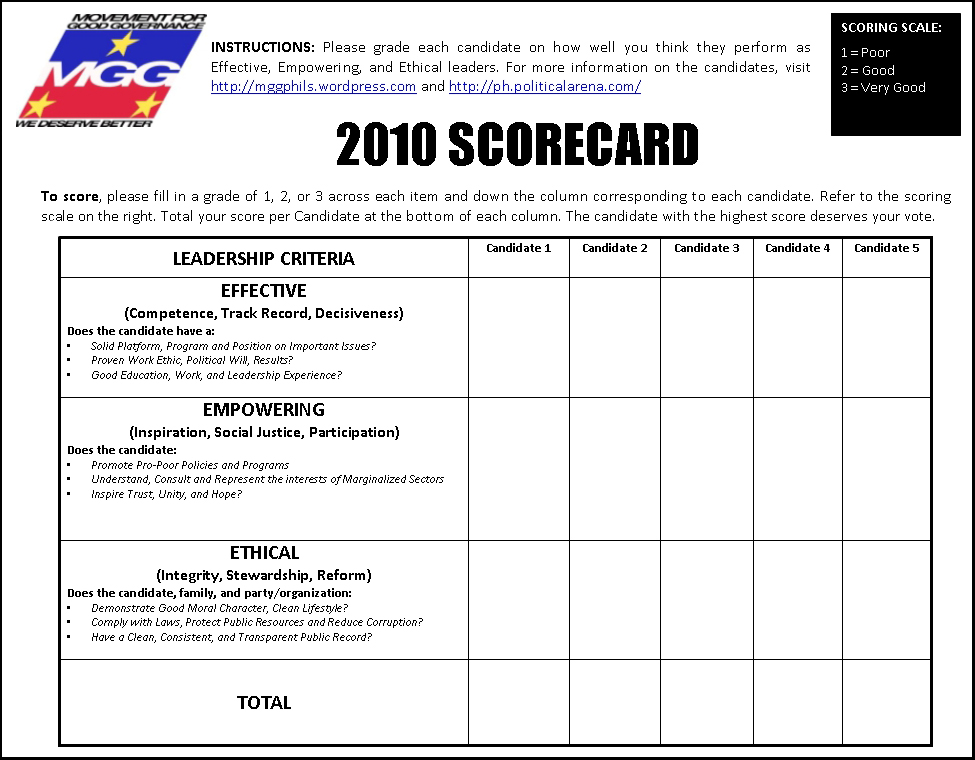
Launched on Friday as the first of its kind in Philippine politics, the scorecard provides “simple and effective guide” to evaluate candidates based on three Es – effectiveness, empowering, and ethical leadership.

The criteria were initiated by the Movement for Good Governance (MGG), a non-partisan, multi-sectoral citizen’s movement, to help voters make the wise choice.

“Instead of saying we want this senator or presidential candidate because we know him or because he is popular, the voters can use the scorecard to evaluate if the candidate has the competence, integrity and care for the poor. We encourage people to evaluate each candidate based on the scorecard,” said Milwida “Nene” Guevarra, one of the convenors of the group.

In a news conference, Guevarra said that voters could assess the candidates based on the three leadership criteria and grade them with 1 (poor), 2 (good), 3 (very good).

Instead of bringing a sample ballot on election day, Guevarra said voters could instead bring their scorecard to guide them in choosing who to vote.

“That way, [our vote] is not dependent on who gives us the sample ballot, but it will depend on how we have evaluated the candidates in terms of the way we feel they are in terms of criteria that we can agree with,” she said, stressing that the scorecard then becomes an empowering tool for the citizens.

The scorecard, which has English and Filipino versions, was crafted using local and international governance benchmarks from Gawad Galing Pook, the World Bank, and the United Nations. It was polished after a series of workshops with multi-sectoral groups, and then finalized with the help of the Personnel Management Association of the Philippines (PMAP), the country’s leading human resource organization.

Guevarra said the scorecard looked at the candidates’ effectiveness or their ability and track record to perform their duty; empowerment, or the candidates’ ability to unite and engage sectors to develop and implement policies and programs that meet the genuine needs of the people; and ethical, which affirms the need for the candidates’ integrity and character.

She said the scorecard has been tested in several schools, where students were asked to choose their presidential candidates first without the scorecard, then listen to a debate of the candidates, and then grade them using the scorecard.

“You can see that there’s a very, very big change in their choice. For example, initially [Senator Francis] Chiz [Escudero] did well, then after the debate and after the students saw the scorecards, they go for [Senator Richard] Gordon,” Guevarra said.

“You can see that people get to be influenced by criteria so when you tend to focus their choices on criteria, their choices differ and what they really want for their choice is to be sound and based on good characteristics,” she added.

Escudero eventually did not pursue his presidential bid.

With 10 days to go before election day, MGG hopes the scorecard can help make the voters choose the right public servants.

News: Manual count rule out today; issues cited

BusinessWorld Online: THE COMMISSION on Elections (Comelec) releases today its unanimous decision on the proposed parallel manual count for national and local positions, with officials hinting an adverse ruling.

“It is not the number of positions involved… Is it proper? Is it legal?… It is of doubtful legality,” said Comelec Chairman Jose A. R. Melo in an interview.

Comelec spokesman James Arthur B. Jimenez said in a separate interview the unanimous verdict considered the input of the commission’s field officials who will conduct the count.

For his part, Commissioner Rene V. Sarmiento said that their field officials were against the proposal due to operational and logistical concerns.

Aside from field official feedback, he said the Comelec Adivsory Council’s (CAC) opinion was also considered.

CAC member Ramon C. Casiple earlier said that the parallel manual count should be conducted by an independent body such as the National Citizens’ Movement for Free Elections (Namfrel) and not by the Comelec.

But Mr. Sarmiento said the parallel count goes against the principles of the random manual count (RMA) as provided for under the automated election law or Republic Act 9369.

“[The law] does not forbid [or] allow [parallel manual count]. [But] it goes against the principles of random manual audit… [In] parallel manual count, all would be counted. Random would be selective. The process is different,” Mr. Sarmiento said.

In a minute resolution of the full commission meeting last April 5, the poll body increased the number of precincts that would be subjected to RMA to five per legislative district from one as provided for by law.

A total of 1,145 precincts would be audited for 229 legislative districts, the resolution read.

Representatives of various groups such as the Makati Business Club (MBC), Management Association of the Philippines, Financial Executives Institute of the Philippines, Alyansa Agrikultura, Philippine Bar Association of the Philippines and information technology professionals held a dialogue with the full commission last Monday to present their proposal for the parallel manual count.

In a letter submitted to the Comelec, the groups said April 29 is the cutoff date to decide on whether or not to hold a parallel manual count.

Compromise

Meanwhile, Namfrel council member Maricor K. Akol said in a separate briefing that the group is willing to trim the positions covered by the manual count to one — the president — from three to include the vice-president and a local position.

“If they are saying that it is going to be expensive and will delay the proclamation, we are willing to bend what we are demanding and limit it to just one candidate,” she said.

Ms. Akol said the law is silent on the random parallel count of votes.

“The Comelec has argued originally that there is a legal bar in this proposal. If you recall, when they said that they used the wrong UV (ultraviolet) ink, their solution was to buy UV lamps to manually verify what was originally an automated activity. They decided on this matter without the benefit of the law. They purchased 80,000 handheld UV lamps to manually verify the ballot. This is the same principle in the parallel manual count,” Namfrel council member Guillermo M. Luz explained.

The commission, he claimed, is printing manual forms for 30% of all the precincts in case there is a failure of automated polls. “What we and the IT professionals are suggesting is for them to already print forms for 100% of the precincts for this verification run.”

The Namfrel has also called for the release of the final guidelines for the random manual audit which have been left pending at the Comelec technical committee.

“We have been asking the Comelec for the GI (general instructions) because this will be the guidelines and basis of the Board of Election Inspectors to proceed with the parallel verification run,” said Namfrel national chairman Jose L. Cuisia, Jr.

In a related development, all precinct count optical scan (PCOS) machines for Visayas and Mindanao have been shipped out from the main warehouse in Laguna province east of Metro Manila, while over half (57%) of the machines assigned for Luzon have been delivered, Comelec said.

A total of 17,077 units were sent to Visayas while 18,202 were delivered to Mindanao.

As of 10 a.m. of April 27, the official ballots deployed totaled 3,594 (21%) for Visayas and 12,936 (71%) for Mindanao.

The ballots are either in transit or have been delivered to the provinces and municipalities.

2010 Election Scorecard for Voters

The MGG Scorecard
English | Filipino

The Movement for Good Governance (MGG), the country’s foremost non-partisan, multisectoral citizens’ movement, is launching a pioneering election tool for voters called the Scorecard that will enable citizens to vote wisely in the upcoming May elections.

The MGG Scorecard is the first of its kind in Philippine politics. It is a simple and effective guide to evaluate candidates based on three key leadership criteria: effectiveness, empowering, and ethical leadership.

The criteria was initiated by MGG using diverse local and international governance benchmarks from Gawad Galing Pook, the World Bank, and the UN. The scorecard was finalized with the assistance of the Personnel Management Association of the Philippines (PMAP), the country’s leading human resource organization.

“This is the first time, not only for the Philippines, but other democracies, where citizens and voters are empowered to choose their leaders wisely,” said Prof. Solita Monsod, MGG Chair. “This scorecard helps Filipinos regardless of social class and background to evaluate candidates in terms of whether they are fit for public office. It enables voters to critically think through all the information, jingles, and gimmicks thrown at them by political campaigns.”

The MGG Scorecard (see attached) uses three equally vital leadership criteria and simple guide questions. It looks at a candidate’s effectiveness, or their ability and track record to perform their duty; empowerment, or a candidate’s ability to unite and engage stakeholders to develop and implement policies and programs that meet genuine needs of the populace; and, ethical, which affirms the need for the candidates integrity and character.

“These three complementary traits are all necessary for our country to be governed as we deserve, and the scorecard allows voters to grade candidates on each criteria using simple guide questions. It also ranks the candidates’ total scores — on a basic 1 to 3 score — to determine who among them meets these traits the best,” says Dr. Milwida Guevara, MGG founder and Gawad Haydee Yorac Awardee.

The scorecard will be shared through MGG’s coalition in the remaining dates of the elections to enable Filipinos to make 2010 count. MGG partner PoliticalArena.com has provided both free mobile and internet access for citizens to add to their information to evaluate candidates effectively to make it easier for citizens to compare facts and actual data on candidate’s performance, personal character, and leadership traits.

“As a pioneering tool for the Filipino voter, we aim to use and continue sharing this not only in 2010, not only in future elections, but also in helping citizens develop a mindset for identifying and choosing excellence in their public leaders. In doing so, they transform themselves into an empowered, vigilant, and demanding citizenry that is vital to making democracy and development work in the Philippines,” Guevara added.

The scorecard may be downloaded from MGG partner websites and will be disseminated to key cities and communities up to election day.

News: Comelec rethinks manual poll count

The Precinct Count Optical Scan (PCOS) machine

ManilaTimes.net: The Commission on Elections (Comelec) on Monday said that it needs more time to decide on whether it would conduct a parallel manual count for the country’s first automated elections on May 10.

It was reacting to a proposal from the elite Makati Business Club (MBC) for such count, whose implementation it said might be harder than it looked.

James Jimenez, Comelec spokesman, referred concerned groups and citizens pushing for the manual tally to logistical and administrative factors that the MBC proposal entails.

“It’s not a simple matter of just saying, ‘we want to do this and, therefore, tomorrow it will be done,’” Jimenez said.

“Hindi ito simpleng bagay lamang. Sino ba naman ang may ayaw ng karagdagang seguridad? Sino ba naman ang may ayaw ng karagdagang validation dun sa resulta? Ngunit ang problema ay ang parallel manual count ay isang masalimuot na activity na kailangan ng maraming elemento na magtutugma para siya gumana ng maayos [The manual count is not a simple matter. Who would reject tightened security for the votes? Who does not want additional validation of the results? The problem is that the parallel manual count is a labyrinthine activity that requires many elements for it to work effectively],” he added.

A factor that the Comelec has to look into, Jimenez said, is how the parallel manual count would impact on other activities of the poll body for the Philippines’ first nationwide automated polls.

The MBC proposed that members of the Board of Election Inspectors (BEIs) manually count the votes for the positions of president, vice president and any of these three local elective positions—governor, congressman or mayor.

The parallel manual count was proposed by the Information Technology (IT) community, which cited the Precinct Count Optical Scan (PCOS) machines having lost the necessary security measures such as digital signature and ultraviolet markings.

“Even if it takes one hour or three more hours and some tens of millions of pesos, it [conduct of parallel manual count] is a step well worth taking because credibility is extremely important in these elections,” MBC Chairman Ramon del Rosario said.

If the difference between the results of the manual count and the count by Precinct Count Optical Scan (PCOS) machines is 1 percent or less, the BEI can immediately transmit the results. But if the difference is more than 1 percent, then, the proposal is to request full manual count for all the elective positions.

MBC Executive Director Alberto Lim said that the tolerance level of the errors is 1 per 20,000 ballots.

In time and motion studies conducted by the business club, there will be three additional hours for conducting the parallel manual count. If there are discrepancies in the ballots in a precinct, a full manual count for that precinct will be conducted, giving an additional two days for the canvassing of votes.

Financial aspect

Lim said that they are not against the automated elections in May, they just want assurance that the PCOS machines will be accurate.

The additional step for a parallel manual count will cost an additional P500 million, much of which will be allocated for the extra hours put in by the BEIs.

Comelec officials said that the financial aspect is not the main consideration since there are other factors that the poll body must consider.

The Philippine Bar Association said that it agrees with the MBC proposal for the parallel manual count not just for three positions but five.

Comelec Commissioner Gregorio Larrazabal said that the commission en banc would make a decision on the MBC proposal in the “next few days.”

What a consumer group simply wants is for the Comelec to clarify whether the conduct of a parallel manual count is feasible.

The poll body on Sunday reportedly said that “it was too late to resort to a parallel manual count” but on Monday also reportedly said that “it had not ruled out the same.”

“This is certainly confusing and it not only erodes the public’s confidence in the automated elections but also highlights Comelec’s lack of transparency with regard to its state of preparedness,” Raul Concepcion, Consumer and Oil Price Watch (COPW) chairman, said in a statement also on Monday.

“This latest flip-flopping only reinforces COPW’s doubts that the automated elections will work,” Concepcion added.

He said that the Comelec should immediately finish distributing some 50 million ballots to the 77,000 clustered precincts and mailing sample ballots with precinct

Concepcion added that the poll body should assure the public that the 82,000 PCOS machines would work during the elections.

During a radio interview also on Monday, Malacañang deputy spokesman Gary Olivar said that the parallel manual count, if allowed by the Comelec, will be useless since the law mandates that it is the results of the automated polls that must be followed.

“A parallel manual count will not help the stability of the elections. The automation of the coming elections is there precisely to address all the problems in a manual system,” Olivar added.
Instead of criticizing the Comelec in the conduct of the automated polls, according to him, the public should support the poll body.

“We have to make up our mind. Once we decide [on automation], let’s go ahead with it. Let’s support the Comelec,” he said.

Presentation: Parallel Manual Count by Gus Lagman [updated]

Attached are two versions of my presentation: the first was delivered last Friday before top news editors of TV and print media; the second was presented this morning during a press conference at the Club Filipino (which was broadcast “live” on ANC).

One difference that might make you wonder is that in the first, I stated that the manual count for all positions would take 2 days. In the second, it’s 4 days. In the first, I was referring only to the precinct activities; in the second, I included the additional two days at the canvassing levels.

It’s only 14-1/2 days before election day and the closer we get to that day, the more difficult it would be to implement our proposed solution to automated cheating. We desperately need the help of media in putting pressure on the Comelec to adopt this parallel manual count (or “100% manual audit”, or “manual verification of results”, take your pick, they’re all the same).

We might get an audience with the Comelec en banc tomorrow morning. Let’s all pray that they agree to our proposal. If they don’t… may God help us.

Thank you and warmest regards,

Gus Lagman

PS: Sonny Marcelo, former Ombudsman, commented this morning, “Usually, people are happy when they are being proven right. But I can see that Gus is unhappy (and truly worried, if I may add) for being now proven right!”