Policy Paper: Economic Growth and Poverty Reduction

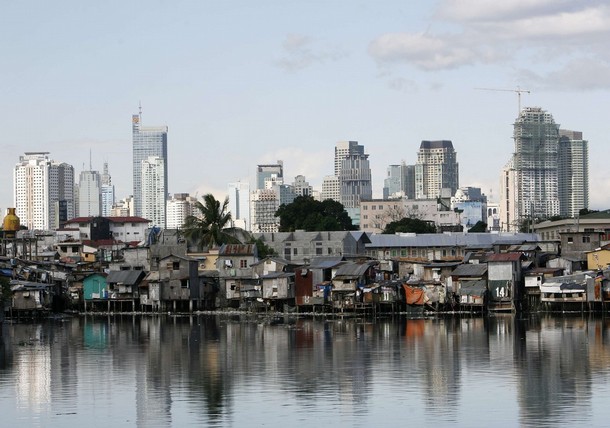
The Philippines was one of the fastest growing economies in Asia in 1960. Its per capita GDP of US$612 was twice as much as Thailand’s and three times as much as Indonesia’s. The situation is now reversed with Thailand’s per capita income being twice as much as that of the Philippines. The growth of the Philippine economy has lagged behind the economies in Asia. Per capita income in the Philippines grew at an average rate of 1.4 percent over 1960 to 2008 while other economies grew at annual rates between 3.6 percent and 6.0 percent.

A direct consequence of the country’s low economic growth is its inability to reduce poverty .The poor increased from 30.0 percent of the population in 2003 to 32.9 percent in 2006. The Gini coefficient, a measure of the inequality in income distribution in the country has remained unchanged at 44 per cent for decades, in contrast to Thailand, Vietnam and Indonesia where reductions in income inequality have been made. The richest 5.0 percent of households in the Philippines account for nearly a third of national income, while the poorest 25 percent account for only 6 percent.

Studies after studies identify binding constraints that the Philippines have failed to address: These are: a) an unstable fiscal position; 2) inadequate infrastructure; and, 3) a weak investment climate. The tax effort has weakened from 17.0 percent in 1997 to 13.0 percent in 2008. Government has perennially been off-track with respect to its revenue targets and finances the budget through borrowings. Debt service takes up more than one-fourth of the budget and the debt stock has risen to P4.2 trillion or 56.3 percent of GDP in 2008. An anemic fiscal position is a major constraint in the provision of adequate public goods and services.

Continue reading the MGG Policy Paper on Economic Growth and Poverty Reduction (First Draft).

Electoral Risks Forum

The COALITION FOR VOTER EMPOWERMENT invites you to be part of the live studio audience of tonight’s Electoral Risks Forum!

Please confirm your attendance with Ms. Chingkel Juan at 898-3221, 898-2913, 898-2617 or 0917-8836555.

The forum will be telecast live on ANC and DZMM– the first of a series of Townhall meetings of the Coalition for Voter Empowerment which aims to empower Filipino voters with good information on the gut issues affecting them. It is crucial for voters to cast informed votes in May 2010, and the Coalition is aiming to engage the youth vote that account for 50% of the voting population.

Issues will be discussed by experts and processed with the audience in ABS-CBN studios (one in Metro Manila, two in the provinces) and candidates on TV-radio (Live on ANC and DZMM Teleradyo, with delayed telecasts in ABS-CBN’s Studio 23, and simultaneous live streaming in abs-cbnnews.com). These will be followed through on Web-based media and social networking sites (Yahoo!, YouTube, Facebook, Twitter, etc.) to help the voters get a better grip of the issues.

Date: 29 January 2010 (Friday)

Time of Forum: 8:00 PM – 9:30 PM – Live on ANC and DZMM

Call Time: 7:30 PM for Guests, 7:00 PM for Audience

Venue: Dolphy Theater, ABS-CBN, ABS-CBN Broadcasting Corporation, Sgt. Esguerra corner Mother Ignacia Sts. Quezon City

Hosts:
Ms. LYNDA JUMILLA
Mr. ANTHONY TABERNA
Mr. GERRY

Confirmed Guests: (MIX OF PANELISTS & AUDIENCE)
Atty. CHRISTIAN MONSOD
Dean RAUL PANGALANGAN
Mr. RONALD LLAMAS
Mr. DREX LAGGUI
Mr. JOEY CUISIA
Comm. GOPYO LARRAZABAL

Policy Paper: Governance and Corruption

The Philippines has been blessed with a variety of assets that can be drawn upon for development, including a dynamic and well educated people, a biologically rich and diverse environment, a location in the fast-growing East Asia region, and a very active civil society . It has great potential for rapid development, but it has remained one that has yet to be fully realized. The country has been overtaken by many East Asian countries in terms of growth and development. Undoubtedly, improvements in the quality of life of the people have lagged significantly behind other East Asian countries and inequality remains high. The World Bank explained the contrast between the country’s potential and its actual development outcomes as a result of the limited ability of public institutions to resist influence by special interests and to work effectively for the common good. This has created a vicious cycle of weak public services, lack of trust in the government, and an unwillingness to provide adequate resources to it.

The Philippines faces a crisis of poor governance. In the political arena, the country is in what has been described as a “democratic recession” characterized by widespread corruption, abuse of power, lack of transparency and accountability, inefficiency, constricting space for people participation, and weakening of democratic institutions (such as the COMELEC, Ombudsman, Judiciary, check and balance between the Executive and the Legislative, etc) .

This paper aims to provide an overview on the problem of governance in the Philippines and present an agenda to strengthen public institutions and the practice of governance.

Continue reading the MGG Policy Paper on Governance and Corruption (First Draft).

News: Puno launches Moral Force Movement

abs-cbnNEWS.com/Newsbreak: Early last year, Chief Justice Reynato Puno was chosen as chairman of the Council for Moral Revolution, a brainchild of former Arroyo ally Jose de Venecia Jr.. Puno eschewed De Venecia’s proposition as he did not want the independence of his office compromised.

“I wish to thank you and the others for electing me in absentia as Chairman of the Council for Moral Revolution…While I agree with the need for moral transformation of all of us, I regret to decline the position in view of the inhibitions of my office as Chief Justice,” Puno wrote the former speaker of the House of Representatives.

However, on Monday, Puno launched the “Moral Force Movement” (MFM) to a cheering crowd of students, religious organizations, and members of the judiciary.

One reason for his sudden turnabout is the fact that the MFM has no politician in the group. Puno tapped civic and religious leaders instead to be the convenors of the movement.

The MFM core group is composed of the following personalities:

  • Parish Pastoral Council for Responsible Voting (PPCRV) chair Henrietta de Villa;
  • Far Eastern University (FEU) Law school Dean Andres Bautista;
  • retired Brigadier General Jaime Echeverria, president and chair of the Association of Generals and Flag Officers (AGFO);
  • Dr. Milwida Guevara, one of the leaders of the Movement for Good Governance (MGG);
  • Emerito Nacpil, retired bishop of the United Methodist Church of the Philippines from 1980-2000;
  • Marixi Prieto, chair of the Philippine Daily Inquirer;
  • Noorain Sabdula, one of the Ten Outstanding Students of the Philippines in 2008;
  • Monsignor Gerardo Santos, president of the Catholic Educational Association of the Philippines (CEAP) and executive secretary of the Episcopal Commission on Catechesis and Catholic Education of the Catholic Bishops’ Conference of the Philippines.

Puno for president?

But with only three months left before the deadline for the filing of the certificate of candidacy for the 2010 elections, speculations will inevitably crop up that Puno’s moral force is actually a vehicle for his impending presidential campaign.

De Villa, however, belied the MFM would support eventually support Puno for president. “It’s (MFM) not pushing for Chief Justice Puno. We’re pushing for moral values,” she told abs-cbnNEWS.com/Newsbreak in an earlier phone interview.

De Villa added that the MFM, while open to support from other groups, is cautious in engaging other organizations openly endorsing candidates in next year’s elections.

FEU’s Bautista said that if Puno decides to throw his hat into the political ring, he will have to disengage from the MFM.

Puno has sought to convince the public that he has no political ambition. He said in his speech on Monday that a “social movement, not a political movement” is the panacea to the country’s problems.

MFM not apolitical

The MFM describes itself as “neither pro- nor anti- administration, but it is not apolitical and neutral since it will stand up for political righteousness.”

Its objective is to see “transformational leadership” in 2010 through a voter’s education program. MGG’s Guevara said that their main benchmark for the credibility of candidates is their track record – how many promises they kept, how many they broke.

The focus will not be on specific issues, such as the debate on the reproductive health (RH) bill, for instance, or charter change. The MFM core group and its members have their own views about these.

Santos, in particular, led the CEAP in an interfaith rally against charter change in 2008. He also signed an ad on CEAP’s objection to the RH bill.

With limited funds, the MFM will bank on the strength of volunteerism to achieve its goals and implement its programs.

PDI’s Prieto said that in case they have to seek help from other organizations, it will not be in exchange for anything since they do not want to be “indebted” to anybody.

The MFM has started to gather possible volunteers. On Monday, it made the attendees during the launch sign a “commitment slip” to MFM.

They were asked what help they could offer, from something as specific as becoming a PPCRV, MGG, or NAMFREL (National Citizens’ Movement for Free Elections) volunteer to something as general as not electing anyone “who bribes, cheats, lies, nor tolerate anyone who does.”

Impropriety

An incumbent chief justice’s involvement with a movement is not without potential controversy since it could raise questions of impropriety.

However, Atty. Marlon Manuel, coordinator of the Alternative Law Group, believes there is nothing wrong with having a chief justice mobilize people to push for better governance.

“He also heads a branch of the government,” Manuel said, which means it’s also his duty to push for reforms.

A Court of Appeals (CA) justice, who asked not to be named, said that it is unlikely that judges will see something wrong with the chief justice’s work with the MFM, including the involvement of religious organizations in the movement.

He said there is nothing wrong if Puno cites the need for a moral force. Religious organizations are also free to back him up.

FEU’s Bautista said Puno is merely exercising his duties as a citizen.

“First, you have to look at Chief Justice Reynato Puno…He is also a citizen like you and me,” he said.

The MFM has emphasized that “Chief Justice Reynato Puno convened the Moral Force Movement as a private citizen concerned about the deterioration of Philippine society.”

Puno should inhibit?

If the leaders and members of the MFM are involved in cases that are before or are brought to the SC, one query that could come is: should Puno inhibit himself?

This issue could come up in the case of PDI’s Prieto. Her family’s company, the Sunvar Realty Development Corp., was recently sued by the Office of the Solicitor General for allegedly using the land formerly owned by the National Power Corp. (NPC) in Makati City.

The case is pending at the Makati Regional Trial Court. In case it reaches the SC, Prieto believes that it would not raise questions of impropriety on Puno.

“The MFM is a movement, it’s not about personalities,” she told abs-cbnNEWS.com/Newsbreak

Dean Antonio La Viña, head of the MFM secretariat, told abs-cbnNEWS.com/Newsbreak that everything has to be done by the rules. He said there is really no clear cut rule on inhibition. He said “the strategy is to stay away from issues that could come to the court or to stay above the fray.”

Bautista believes Puno will do the right thing if and when these issues come up before the Supreme Court. “If and when such an occasion arises, he will know what to do,” he said.

But Vincent Lazatin, convenor of the Supreme Court Appointments Watch, took a different viewpoint.

“It is wise for the chief justice to inhibit,” he said, as his “special relationship” with the group amounts to identifiable ties.

News: Talakayan 2010 to tackle economic issues

PhilSTAR.com: Talakayan 20.10, an issues-based forum that pushes national leaders to share their vision and position on issues of national importance, continues its leadership forum series at 3 p.m. tomorrow (Aug. 27) at the Asian Institute of Management (AIM) in Makati City.

The focus of the discussion will be economic issues.

“This is a great opportunity for the voting public to listen to the candidates running in 2010, how they plan to address the issues on the economy,” said Bill Luz, chairman of the Movement for Good Governance (MGG).

Guests who will cover the event live on their blogs and social networking sites will be given free entrance passes and free Internet access, while students will be given 50 percent discount from the P200 registration fee.

Meanwhile, Filipinos in San Francisco, New York, London, Rome, Riyadh, Tokyo, Sydney and other parts of the globe can catch the live Web streaming of Talakayan 20.10 on http://www.philstar.com. The forum will be aired on GMA7 and Radio Veritas.

“We at philstar.com, want to allow our kababayans both here and abroad to participate in these forums without actually being there. We feel it is our duty and responsibility,” said Katrina Sandejas-Mañosa, general manager of philstar.com, the online portal of the STAR Group of Publications for the Filipino global community.

In partnership with the Makati Business Club, Management Association of the Philippines, YouVote Philippines and Rotary International District 3830, philstar.com, GMA7 and Radio Veritas, Talakayan 20.10 will be held at the SGV Hall of Asian Institute of Management in Benavidez St., Legaspi Village, Makati City.

Viewers outside the Philippines can catch the live broadcast at the following times: San Francisco (12 a.m.), New York (3 a.m.), London (8 a.m.) Rome (7 a.m.), Riyadh (10 a.m.), Tokyo (4 p.m.), Sydney (5 p.m.).